
From Gatekeepers to Protocols: The Case for On-chain Listings
by Phoebe Beigbeder and – February 12, 2026
Off-chain vs. On-chain listing
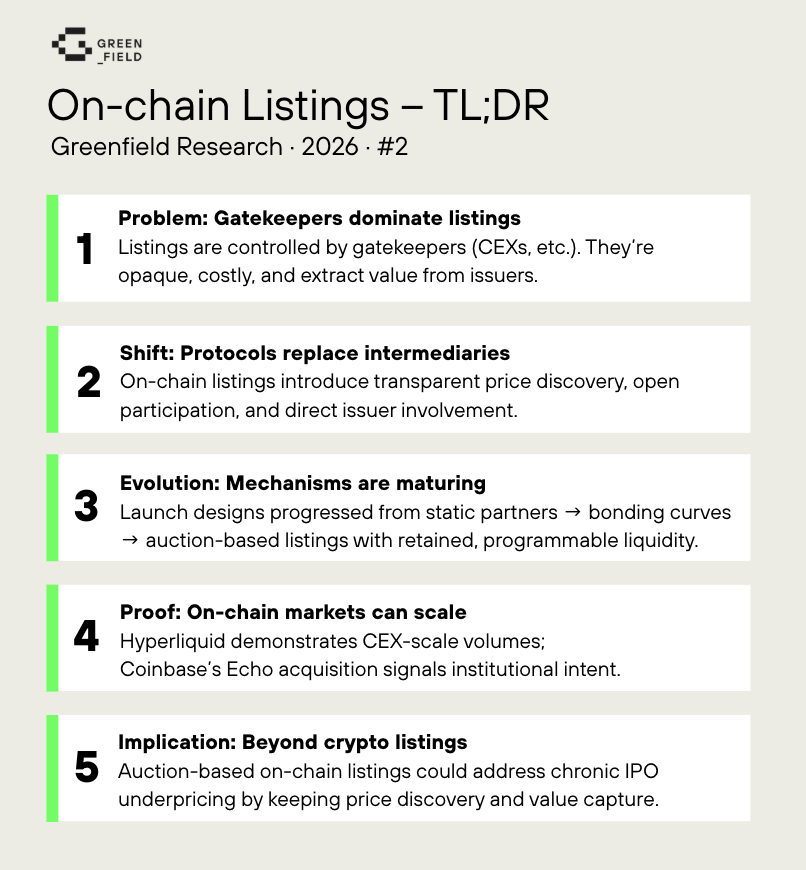
Token listings remain one of the least transparent yet most influential parts of the crypto market structure. Despite the promise of permissionless finance, access to liquidity is still largely governed by centralised exchanges. Their dominance has created a system where entry to the market depends on opaque decisions, high costs, and limited access, with a dynamic that favours scale and reputation over innovation. At the same time, new on-chain mechanisms are beginning to challenge this model. As programmable markets mature, they offer a path toward transparent price discovery, direct issuer participation, and fairer value capture. This piece explores why on-chain listings are growing in importance and how they could evolve into the blueprint for the next generation of public markets.
The current landscape: Dependence on centralised listings
In the current crypto market structure, centralised exchanges are the primary venues for price formation and liquidity, especially for newly listed assets. Professional market makers anchor valuations on CEX order books and then arbitrage any gaps that open on decentralised venues.
For smaller projects, particularly those without established brands or institutional backing, decentralised exchanges often struggle to sustain deep, reliable liquidity, reinforcing a dependence on centralised venues for perceived legitimacy. In practice, DEX prices tend to track CEX benchmarks, and a major CEX listing is still widely regarded as the token’s “true” market debut. Centralised exchanges therefore retain significant gatekeeping power over discovery and distribution, and they monetise this influence through both explicit and implicit listing economics. This selectivity is visible across ecosystems: for example, some leading Base-native projects such as Zora, Aerodrome, and Clanker are not listed on Binance, while entire categories of assets like portions of the Solana or gaming and consumer token ecosystems remain underrepresented, even as more speculative memecoins are onboarded with relatively few frictions.
The centralised listing process itself can be opaque and extractive. Projects have reported months-long delays between an initial application and listing, with shifting requirements. Some of our portfolio projects/companies report that exchanges ask for substantial allocations from a project’s treasury, often millions of dollars’ worth of tokens or direct listing fees. This dynamic places smaller teams at a structural disadvantage that increases the leverage of CEX gatekeepers over market entry timing. CEX launchpads, such as Binance Launchpad and OKX Jumpstart, are another layer of centralised control. They offer massive user funnels and built-in liquidity on day one, but at a high cost in both economics and flexibility. Teams must meet strict criteria, surrender significant token allocations, and follow the exchanges’ distribution and marketing playbook. While these launchpads can deliver impressive initial volumes, they also lock projects into a platform-first, issuer-second model that runs counter to the permissionless ethos of DeFi.
Against this backdrop, a new generation of on-chain launch mechanisms has emerged, aiming to restore openness, transparency, and fairness to the listing process. What began as simple experiments in permissionless liquidity is now evolving into structured systems for price discovery and issuer alignment.
The emerging alternative: Evolution of on-chain token launches
Each new design for on-chain token launches has arrived in stages, each one patching specific flaws of the last, while introducing its own caveats and tradeoffs.
The first stage of on-chain token launches relied on permissionless liquidity provisioning. Teams manually created Uniswap V2 or V3 pools, funding both sides, but if ETH’s price doubled elsewhere, arbitrage could leave an LP with about $4,896 instead of $5,000. While trading became immediately available, this model did not optimize for fair price discovery, as static liquidity was vulnerable to external arbitrage and execution inefficiencies.
The second stage emerged with one-click bonding-curve launchers such as Pump.fun on Solana. These platforms removed the technical barrier entirely, allowing anyone to deploy a token with instant primary liquidity through a simple UI. Pump.fun became a breakout success, generating roughly $900M in revenue and facilitating the creation of over 15 million tokens. Over time, however, the limitations of this issuance-only model became clear, with value concentrating around early participants and prompting the market to move beyond simple launch mechanics toward more sustainable structures. This meant value accrued mainly to early buyers and secondary venues, not to issuers or the launchpad itself.
The third stage aimed to capture value across the token’s lifecycle. Virtuals required all agent tokens to trade against VIRTUAL, generating continuous revenue but forcing a reflexive intermediary pair that reduced liquidity efficiency.
The fourth stage delegated on-chain market making to external entities. Morpho used Aera for its launch, depositing tokens upfront into a dedicated market-making smart contract that could only be used for liquidity management. While secure, this model is costly, since it requires continuously paying an external market maker and pre-funding inventory that the protocol can’t easily redeploy. It also reintroduces an offchain relationship layer and opaque strategy decisions, limiting composability and making liquidity feel more like a service contract than a native, governable on-chain primitive.
The fifth stage, seen in Whetstone’s Doppler (and partly in Clanker and Flaunch), focuses on price discovery and liquidity retention. Dutch auctions set fair initial prices, dynamic bonding curves resist sniping, and LP positions are tokenized into treasury assets rather than sunk costs, marking a maturation of on-chain listings.
Tokenized LP positions turn launch liquidity from a sunk cost into a yield-bearing treasury asset. Because the LP is an owned, tokenized claim on the pool, the protocol keeps skin in the game and earns fees instead of just spraying incentives. That base of “owned liquidity” is sticky, making depth more resilient after the initial hype window. It’s also programmable: LP tokens can be vested, governed, or plugged into vaults and backstops instead of being dead capital. Treasuries can rebalance across pools and chains by moving LP claims rather than rebuilding liquidity from scratch. In practice, this shifts listings from one-off marketing events to ongoing balance-sheet and market-structure management.
An emerging sixth stage extends this auction logic into governance itself. MetaDAO exemplifies this direction by using futarchy-style on-chain auctions not just to launch tokens, but to decide which proposals, products, or parameter changes should exist at all. Rather than governance voting followed by a launch, markets are the governance layer. Capital allocation, price discovery, and collective decision-making collapse into a single on-chain process. In this model, token launches are no longer isolated events; they are expressions of continuous, market-driven coordination.
Now, this shift toward auction-based market design is not limited to token launches. Uniswap’s Continuous Clearing Auctions (CCA) are compelling because they challenge one of the oldest assumptions in on-chain trading: that faster is better. CCA replaces continuous order flow with short, repeating batch auctions, aggregating orders and clearing them at a single uniform price each block. By concentrating liquidity in time rather than across an order book, CCAs reduce latency advantages, dampen MEV-driven sniping, and improve execution quality for large or informational trades. While designed for secondary markets, CCA reflects the same broader architectural move toward auction-based clearing as a first-class on-chain primitive for fairer price discovery.
The perception gap & why on-chain listing remains non-consensus
The public image of on-chain listings is still dominated by memecoins. Platforms like Pump.fun have become cultural hubs for speculative assets, creating a narrative that “on-chain only” equals unserious. While these launches have produced headline figures like Pump.fun’s hundreds of millions in fees or Clanker’s $2.7B in lifetime trading volume, the association with memes overshadows the structural advances in mechanism design. Farcaster’s integration of Clanker shows how on-chain trading is increasingly being embedded into social distribution. Meanwhile, Neynar’s acquisition of Farcaster underscores the growing strategic value of the infrastructure layer built around these networks, including identity, distribution, and developer tooling, well beyond speculative token trading.
Even promising second-wave platforms such as Doppler are still in their early growth phase; in its initial rollout, Pure (the Doppler ecosystem interface) processed 205 tokens in two weeks, generating about $10k in first-week protocol fees. However, it has some difficulties keeping their traction in the long term.
Yet despite these efforts, no major, high-profile project has recently committed to a fully on-chain listing without a follow-on CEX debut. The largest and most visible launches still opt for a hybrid approach: building initial liquidity on DEXs, then seeking a centralised listing for market reach, market-maker coverage, and legitimacy in the eyes of institutional participants. This absence of a flagship, purely on-chain, “serious” launch reinforces the perception that CEXs remain indispensable for large-scale token distribution.
Again, while creator coins minted via Zora’s interface on Base were purely on-chain and traded in decentralised pools without any CEX involvement, the official native ZORA token followed a hybrid launch with CEXs and DEXs.
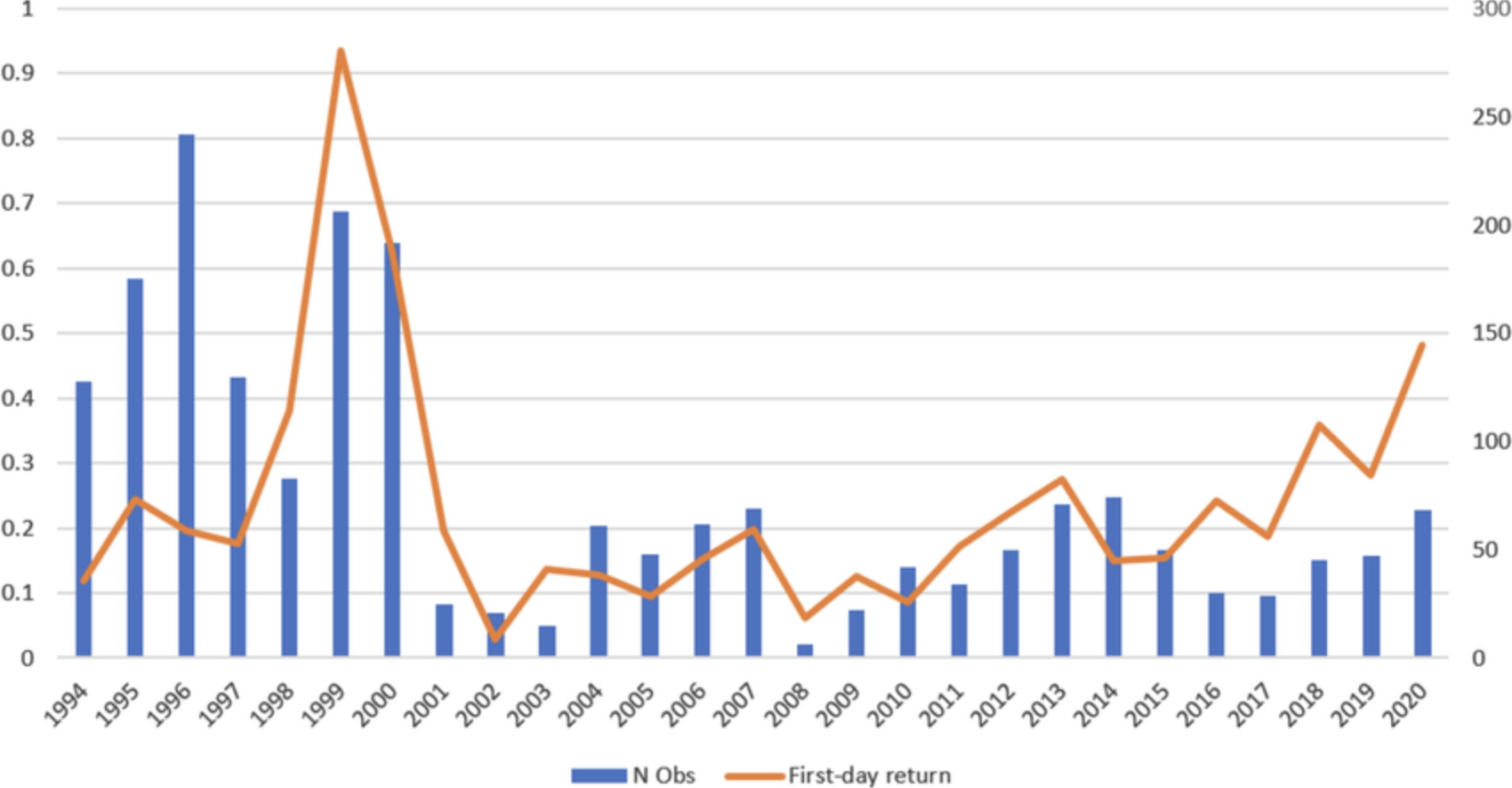
This perception gap limits how far the conversation around on-chain listings has evolved. Most still view these mechanisms as niche tools for token launches rather than as a foundation for broader capital formation. Yet the underlying principles of transparent price discovery, open participation, and issuer-aligned incentives address inefficiencies that extend far beyond crypto. The same dynamics that define token listings today mirror long-standing issues in traditional markets, most visibly in the structure of the IPO.
Source: Research Gate
This graph shows that high first-day IPO returns indicate offerings are often underpriced, causing issuers to leave substantial capital on the table. These gains flow mainly to a small group of early investors, reinforcing unequal market access. The pattern highlights structural inefficiencies in the IPO process that on-chain mechanisms could address through fairer, more transparent pricing. Bringing this model to IPOs would merge TradFi’s deep capital and regulation with crypto’s tested, programmable market designs. A listing protocol could become a profitable business, competing with investment banks on both fairness and cost while better aligning incentives with issuers.
On the other hand, Hyperliquid demonstrates that fully on-chain markets can rival CEXs in scale when the mechanism and user experience align. Operating its own L1 with a high-throughput CLOB and liquidity vaults, Hyperliquid has recorded months with over $396B in perpetual trading volume and regular daily figures between $8B and $20B. This shows that the technology stack and user adoption curve for deep on-chain liquidity already exist in a working example.
The integration of Whetstone’s Doppler into Zora’s platform shows how programmable price discovery can extend into the creator economy. By embedding dynamic auctions and liquidity-streaming mechanics, Zora enables creators to launch tokens with transparent clearing and long-tail liquidity on-chain. At the intersection of TradFi and crypto, the business model matters as much as the mechanism: Doppler captures value like an exchange by charging 10 bps on trading fees and 5% of lifetime LP fees, while Pure Markets is set to add interface fees, showing how protocols themselves can operate as scalable businesses.
In more traditional token categories, early-stage results like $PENGU made high volumes the first 48 hours on Raydium than on Binance, and the traction of AI-themed tokens such as Virtuals and AI16z (with Virtuals generating roughly $39M in platform revenue) show that, in certain verticals, on-chain listings can outperform centralised channels during their most critical initial window. Yet the challenge is proving this model can sustain projects with durable value, as most memecoins crash after the initial hype.
Recent moves such as Coinbase’s acquisition of Echo, an on-chain capital formation platform for early-stage investments, highlight how established exchanges are preparing for programmable, transparent public listings. Echo’s model, focused on on-chain issuance and investor access, aligns directly with the thesis that tokenized listing rails could modernize the IPO process. As Brian Armstrong has stated, the current regulatory environment incentivises companies to stay private for too long, limits early price discovery, and concentrates value among private investors, a dynamic he believes fully on-chain public markets could improve by lowering costs, reducing friction, and increasing access.
Conclusion
At Greenfield, we are actively exploring and investing in these emerging market structures.
On-chain listing is more than bypassing centralised gatekeepers; it’s a way to make price discovery transparent, fair, and aligned with issuers and communities. In IPOs and centralised crypto listings, much of the early trading gain still flows to intermediaries and fast actors.
A major hurdle is the regulatory vacuum. Traditional IPOs have rigorous disclosure, audited statements, and compliance frameworks that give institutions confidence. On-chain listings lack standardised disclosure, investor protections, and oversight by leaving a market that is open and efficient but too opaque for most large allocators. Until a framework emerges that combines blockchain’s transparency with traditional market safeguards, institutional adoption will remain limited.
On-chain listing must also prove it can match exchange depth, win trust from serious projects, and move beyond the memecoin narrative. With a total addressable market of roughly US $20B annually in IPO underwriting fees, even a small share captured through transparent, issuer-aligned mechanisms would mark one of the biggest shifts in capital markets in decades.
At Greenfield, we are always excited about new primitives, so do not hesitate to reach out at claude@greenfieldcapital.com!