
Why Blockchain Networks Are Europe’s Missing Resilience Layer
by Sebastian Blum – April 10, 2026
This piece argues that Europe’s digital sovereignty debate is asking the wrong question. The focus on who owns the infrastructure – American or European companies – misses the more fundamental issue of how it’s built. Replacing AWS with a European cloud provider changes the flag on the data center; it doesn’t remove the single point of failure. Blockchain networks, by contrast, deliver the resilience properties Europe’s own regulatory frameworks demand, no central operator, no kill switch, no single jurisdiction, and have been proving it in production for over a decade. The infrastructure exists. The question is whether Europe will recognize it as part of the answer.
On March 1–3, 2026, drone strikes damaged three Amazon Web Services data centers in the UAE and Bahrain.[1] Banking apps went offline. Payment platforms stalled. Enterprise systems across the region suddenly stopped responding. AWS advised customers to migrate workloads out of the entire region. Days later, HSBC closed all branches in Qatar, Citigroup and Standard Chartered evacuated their Dubai offices, and Goldman Sachs restricted access to offices across the Middle East – after Iran threatened to target US and Israeli-linked financial institutions.[2] The digital and financial infrastructure of an entire region was shutting down simultaneously.
What had long been described as “the cloud”, an abstract and borderless utility, revealed itself as physical infrastructure, concentrated in a small number of locations, owned by a small number of companies, and vulnerable to the same shocks as any other strategic asset. The disruption did not stay regional. It cascaded to services far beyond the Middle East, reminding us that in a hyper-connected world, a failure anywhere can become a failure everywhere.
For decades, digital infrastructure has been optimized primarily for efficiency. Centralization reduced costs, simplified operations, and accelerated innovation. But it also created new forms of fragility. When critical systems depend on a small number of providers, failures, whether technical, political, or physical, no longer remain local events; they cascade.
The economic impact is immense: IT downtime costs the world’s largest 2,000 companies an estimated $400 billion every year – and that figure is rising.[3] Over the past decade, the cumulative toll of cloud outages, infrastructure failures, and cascading system breakdowns has run into the trillions. These are not primarily the costs of cyberattacks. They are the costs of architectural fragility: building critical systems around a handful of centralized providers where a single failure can ripple across industries and continents.
The pattern had appeared before: On July 19, 2024, a routine software update from CrowdStrike, a cybersecurity firm whose software runs on roughly 60% of Fortune 500 systems, brought down 8.5 million computers worldwide.[4] Airlines across three continents grounded flights. Hospitals turned patients away. Payment systems froze. Emergency services went dark. The cause was a routine update. Global financial losses from this single incident exceeded $10 billion.[5]
Infrastructure risks tend to follow a pattern: they are visible early to those working close to the systems and only become obvious to everyone else after something breaks. Counter-drone defense was considered a niche concern until drones began reshaping battlefields and threatening NATO airspace. Cloud concentration was an abstract policy debate until a single software update paralyzed global commerce. The question is whether we will recognize the next vulnerability before or after it is exploited.
That asymmetry should trouble anyone thinking about Europe’s digital future because Europe’s dependency is, in many ways, deeper than most people realize.
What We Talk About When We Talk About Resilience
Before getting to any particular technology, it is worth being precise about what resilience actually means, because the term is everywhere in European policy documents – from DORA to NIS2 to the CER Directive – but its implications are often underappreciated.
In most industries reliability is the goal. Systems should work most of the time, and when something goes wrong, it is treated as an exception. Critical infrastructure is designed differently. Energy grids, telecommunications networks, and transportation systems are not built under the assumption that failures will never occur. They are built with the expectation that failures are inevitable. Components will break. Operators will make mistakes. Adversaries will interfere. The goal is not to eliminate failure entirely, but to design systems that continue functioning even when parts fail.
This idea is generally described as resilience. It is a fundamentally different design philosophy from reliability. Reliability asks: how do we prevent things from going wrong? Resilience asks: how do we keep operating when they do?
The EU’s own Digital Operational Resilience Act (DORA), which came into force in January 2025, defines it as the capacity to “withstand, respond to, and recover from all types of ICT-related disruptions and threats.”[6] The NIS2 Directive aims for a “high common level of cybersecurity resilience” across 18 critical sectors.[7] The EU’s Critical Entities Resilience (CER) Directive goes further still, requiring that critical infrastructure be able to “prevent, protect against, respond to, resist, mitigate, absorb, accommodate, and recover from” incidents – an all-hazards approach covering everything from natural disasters to geopolitical shocks.[8]
Strip away the legal language, and the core properties are intuitive. A resilient system has no single point of failure. If one component goes down, the rest continues. It distributes critical functions across many nodes and locations. It isolates faults so they do not cascade. It draws on diverse technologies and vendors so that a single vulnerability does not compromise everything. And crucially, its rules are predictable and transparent. They cannot be changed unilaterally by any single actor.
Think of the internet itself. It was originally designed so that military communications could survive a nuclear strike by routing around damaged nodes. No central hub. No master switch. That architectural principle, not any particular technology, is what made it resilient.
The question Europe faces today is whether the digital infrastructure it depends on still embodies that principle. The evidence suggests it does not.
The Dependency Problem
Europe’s vulnerability is not the result of a single dependency but of several overlapping ones. Economic concentration, legal jurisdiction, and control over core digital infrastructure together create a system in which critical services ultimately depend on actors outside of Europe’s control.
Market Concentration
The first layer of dependency is economic concentration.
US cloud providers (Amazon Web Services, Microsoft Azure, and Google Cloud) now control roughly 70–85% of the European cloud market, depending on which segment you measure.[9] European providers’ share has dropped from approximately 29% in 2017 to around 15% today.[10] The European cloud market reached €61 billion in 2024, but AWS alone planned to spend over $100 billion on capital expenditure in 2025, more than the entire European cloud sector combined.[11] Europe’s two largest cloud providers, SAP and Deutsche Telekom, hold roughly 2% market share each.[12]
This is not merely a question of competition. When critical infrastructure becomes concentrated in a handful of providers, failures can propagate across entire sectors simultaneously.
Jurisdictional Dependency
The second layer is legal.
Under the US CLOUD Act of 2018, American law enforcement can compel US companies to hand over data stored anywhere in the world.[13] This creates an unresolvable tension with GDPR: providers face sanctions under US law for refusing CLOUD Act demands, and fines of up to 4% of global annual turnover under European law for complying with them.[14] Jurisdiction follows ownership, not geography. Data hosted on European soil, in a European data center, operated by a US company, is legally accessible from Washington.
More broadly, digital infrastructure operated by companies under a single jurisdiction can become subject to political decisions in that jurisdiction.
In May 2025, when a US executive order sanctioned the Chief Prosecutor of the International Criminal Court (ICC), he reportedly lost access to his Microsoft-hosted email – and potentially to a broader range of Western digital services subject to sanctions compliance.[15] This was not a technical failure – it was a demonstration that political decisions in one jurisdiction could sever an international institution’s access to its own communications infrastructure. Politico described it as “Exhibit A” in the argument about US platform control as a geopolitical instrument.[16] By November 2025, the ICC announced it would replace Microsoft entirely with OpenDesk, a German open-source alternative.[17]
Infrastructure Control
The third layer concerns control over core digital rails.
Visa and Mastercard dominate European card payments. SWIFT, the messaging system underpinning global finance, processes approximately 44 million messages daily across 11,500 institutions in over 200 countries.[18] Its weaponization is no longer hypothetical: Iranian banks were disconnected in 2012, and seven major Russian banks were cut off in 2022, causing the ruble to plunge more than 30%.[19] Whatever one thinks of the geopolitical rationale, the precedent is set: financial infrastructure can be switched off.
Structural Dependence
At a broader level, the dependency extends beyond individual sectors.
The EU imports more than 80% of its digital products, services, infrastructure, and intellectual property from non-EU countries.[20] US companies captured over 80% of global AI funding in 2025, more than €100 billion, while Europe attracted just €7 billion.[21] Nearly all major social media, messaging, and productivity platforms used daily by European citizens and institutions are American-owned and operated.
The Dutch Parliament recently warned that the country’s digital infrastructure is “dangerously dependent on American providers” and called for a contingency plan.[22] A Wire survey found 63% of European IT and compliance leaders would switch to EU-based tools if viable alternatives existed.[23] Search demand for “European alternatives” has surged 660% year-over-year.[24]
The dependency is structural. And as recent episodes demonstrate, it is not abstract.
Designing for Resilience
One instinctive answer is to build more infrastructure at home: European cloud providers, European data centers, European platforms. But does this solve the underlying problem?
China offers a useful illustration. During the CrowdStrike outage mentioned earlier, the country was largely unaffected. That, however, should not be mistaken for greater resilience. China’s digital infrastructure runs on a different technology stack dominated by domestic providers rather than the same Western vendors. The structural problem remains: critical services are still highly centralized, concentrated among a handful of companies, including Alibaba Cloud, Tencent Cloud, and Huawei. The dependency has simply shifted from foreign platforms to domestic ones.
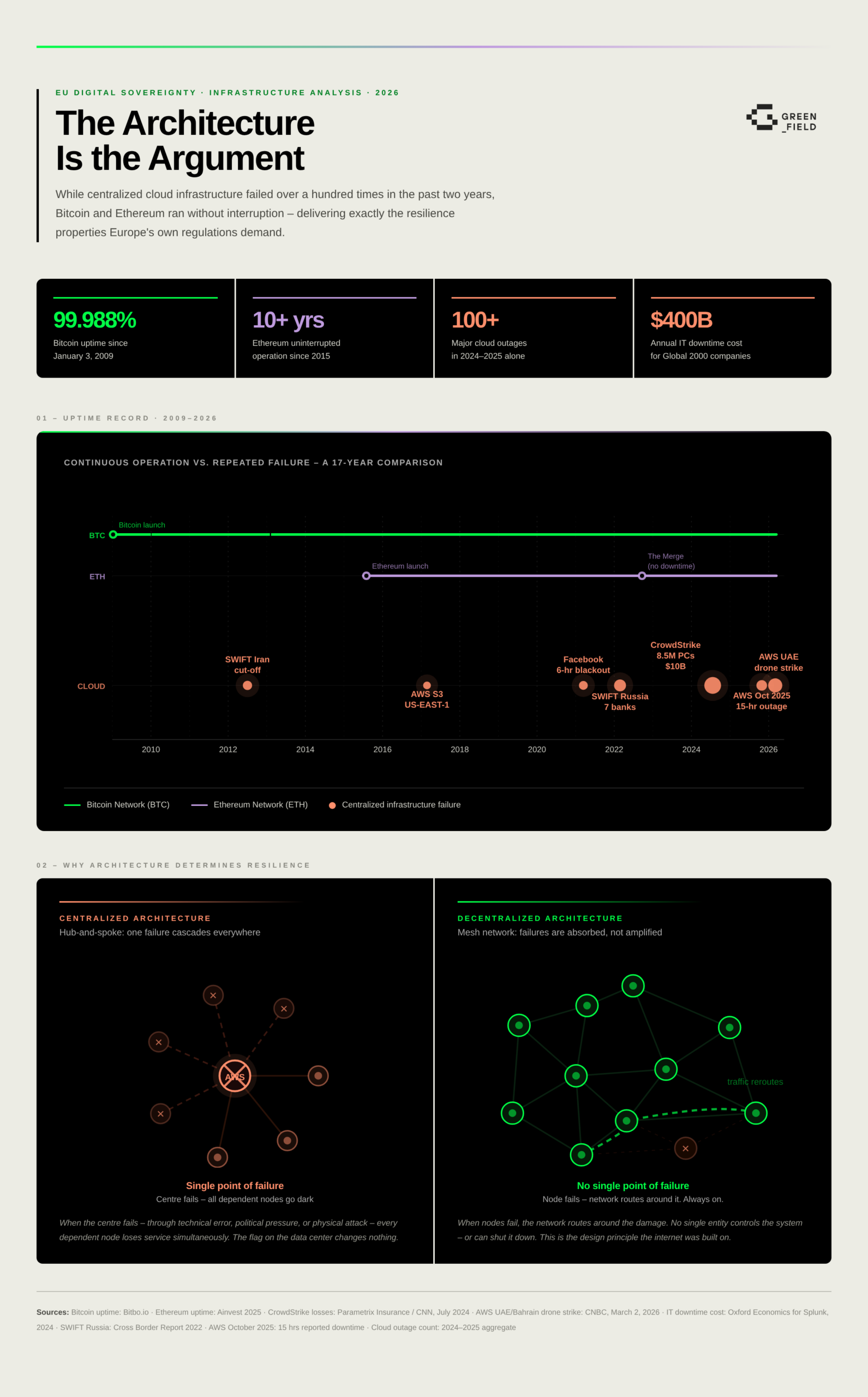
Resilience is not ultimately a question of nationality. It is a question of architecture.
A system built around a handful of operators, whether American, European, or Chinese, will always carry structural risks: concentration, legal pressure, and single points of failure. National ownership may mitigate foreign political leverage, but it does not solve the deeper architectural problem of centralized control.
The real question is whether digital infrastructure can be designed in a way that removes those failure points altogether.
The Infrastructure Nobody Talks About
There is a category of digital infrastructure that has been operating continuously, in public, under adversarial conditions, for over a decade. It rarely enters the European sovereignty debate. Not because it is unproven, but because the public conversation around it has focused almost entirely on the wrong things.
The public debate fixates on token prices and speculation. Beneath the headlines, blockchain networks have quietly become some of the most resilient digital infrastructure ever built.
Consider the record. The Bitcoin network has achieved 99.988% uptime since its launch on January 3, 2009.[25] It experienced exactly two brief downtime events in its early years, in 2010 and 2013, totalling under 15 hours. Since March 2013, it has operated continuously, 24 hours a day, 365 days a year, for over 12 years without a single interruption.
Ethereum, the second-largest blockchain network, has maintained uninterrupted service for over ten years since its July 2015 launch.[26] In that time, it has undergone 18 major protocol upgrades, including a complete transition of its consensus mechanism (from proof-of-work to proof-of-stake in September 2022), all without a single second of downtime.[27] It now operates with over one million active validators across more than 70 countries, processing approximately 1.8 million transactions per day.[28]
To put this in perspective: during a single 12-month period in 2024–2025, AWS, Azure, and Google Cloud collectively suffered over 100 outages. In that same period, the major blockchain networks experienced zero.
It is a direct consequence of how these networks are built.
A blockchain network typically has no conventional CEO, no headquarters, no single data center, no single jurisdiction that can be targeted, pressured, or shut down. The degree of decentralization varies across networks – but the leading public blockchains demonstrate these properties at scale. The Bitcoin network runs on more than 9,000 independent nodes operated by unrelated parties around the world. If a hundred of them go offline simultaneously, the network continues to operate. If an entire country bans participation, the network continues. The rules of the system are encoded in open-source software that anyone can inspect, and changes require broad consensus. No single entity can alter them unilaterally.
These are precisely the resilience properties that DORA, NIS2, and the CER Directive demand: no single point of failure, distributed operations, fault isolation, vendor diversity, and predictable, transparent rules. The EU has defined what resilience looks like in great detail. Blockchain networks are the infrastructure that delivers it by design.
Proof Under Pressure
The strongest evidence comes not from uptime statistics but from moments of real crisis, situations where centralized systems failed, and decentralized networks did not.
April 2018, China: When a letter describing institutional misconduct was censored across WeChat and other platforms, someone posted it as a transaction on Ethereum.[29] The Chinese government, arguably the world’s most capable digital censor, could not remove it. The blockchain became an archive beyond any single state’s reach.
February 2022, Ukraine: When Russia invaded Ukraine, the country’s banking system was severely disrupted. The central bank restricted digital transfers. Banks faced runs. The hryvnia plunged. Within days, the Ukrainian government posted blockchain wallet addresses on social media and began accepting BTC, ETH and stablecoins. Over $225 million in donations flowed in through decentralized networks.[30] Government workers and soldiers received emergency payments when banks were offline. The Deputy Minister of Digital Transformation later acknowledged that blockchain-based finance helped the country navigate the war’s first critical days.[31]
That same month in Canada, when the government invoked emergency powers to freeze bank accounts linked to the Freedom Convoy protests against COVID-19 mandates and GoFundMe deplatformed their fundraising campaign, BTC donations continued to flow because no government or intermediary could freeze them at the protocol level.[32] One can debate the politics; the architectural point is the same. No centralized actor could interrupt the network.
And during every major cloud outage of 2024–2025, including the October 2025 AWS failure that paralyzed thousands of companies for 15 hours, the major blockchain networks continued processing transactions without interruption.
What a Resilient Infrastructure Stack Actually Looks Like
It is one thing to argue that blockchain networks are resilient in the abstract. It is more useful to show what a layered resilient infrastructure actually looks like in practice. Resilience is not a single product or protocol, but an architecture that spans multiple layers.
At Greenfield, we invest across the full blockchain infrastructure stack. Where systems have structural weaknesses, entrepreneurs build solutions, and those solutions create markets. The current geopolitical moment has made Europe’s dependence on infrastructure more visible, but the commercial opportunity to build more resilient systems was clear well before then.
Three projects from our portfolio illustrate how this plays out across different layers of the stack.
Nym: Privacy as a Critical Utility
Metadata, who you talk to, when, and from where, is one of the most valuable targets for modern surveillance. Many communication systems today encrypt message content, but still expose these patterns. In certain contexts, that metadata is enough to monitor, filter, or block participation entirely. The ICC lockout illustrated one dimension of communications dependency – access revoked by a single vendor under political pressure. Nym addresses a different but related vulnerability: the exposure of metadata itself.
Nym treats privacy like a fundamental utility. Built on academic research from KU Leuven and EPFL, it operates a decentralized mixnet that shuffles encrypted traffic across a network of independent nodes, making it impossible for even a powerful adversary to trace communication patterns.[33] Unlike traditional VPNs, which route traffic through centralized servers that the provider can still monitor, Nym’s architecture means that even Nym itself cannot see user activity.[34] It is open-source, modular, and can be integrated into any internet application as a transport-layer privacy upgrade.[35]
The principle: even the pipes through which data flows should not have a kill switch. For any enterprise protecting trade secrets, any government handling sensitive communications, or any institution operating in an adversarial environment, that is critical infrastructure.
Safe: The Programmable Vault
Centralizing asset custody with a single institution creates obvious risks. Yet fully self-custodied systems that rely on a single private key can be just as dangerous. A compromised key, a custodian failure, a court order in a single jurisdiction, any one of these can freeze or seize funds.
Safe solved this by creating the smart account standard for blockchain networks. Instead of one password or one key, it operates as a programmable vault that requires a configurable threshold of independent keys to authorize any transaction, eliminating the single point of failure that plagues traditional custody.[36] The model mirrors dual-authorization controls used in traditional finance, but extends them with on-chain transparency, formal verification, and zero vendor lock-in.[37]
The numbers reflect the maturity: over $1 trillion in total volume processed, more than 57 million wallets deployed, and over $60 billion in value currently secured.[38] Safe’s smart contracts are among the most audited on Ethereum, trusted by the Ethereum Foundation, VanEck, Tether, Chainlink, and many of the most security-conscious organizations in the space.[39] Vitalik Buterin, Ethereum’s co-founder, has stated publicly that he uses Safe for over 90% of his personal funds.[40]
Most recently, Safe launched Safenet, a decentralized validator network that enforces transaction security at the protocol level before any funds can move, replacing centralized warning systems with cryptographic attestations verified on-chain.[41] Greenfield serves as one of six genesis validators.
Arcium: The Encrypted Supercomputer
Until now, processing sensitive data, medical records, financial transactions, and supply chain intelligence, required trusting a cloud provider to see that data while it was being handled. The CLOUD Act means that trust increasingly entails jurisdictional risk: data processed on US-owned infrastructure is legally accessible from Washington, regardless of where the servers are located.
Arcium offers a fundamentally different approach. Its confidential computing network uses Multi-Party Computation (MPC) to allow encrypted data to be processed collaboratively by decentralized nodes, without any single participant ever seeing the full raw information.[42][43] Think of it as a supercomputer that computes results without ever decrypting the inputs.
Arcium launched its Encrypted Ecosystem in March 2025 with over 25 projects across DeFi, AI, healthcare, and enterprise exploring its technology.[44] In practice, this means a European hospital could run AI-driven research across patient data from multiple countries — without any single cloud provider ever seeing that data, and without creating CLOUD Act exposure.[45]
These three layers, private communications, self-sovereign asset management, and encrypted computation, are not the complete picture. But together they illustrate what a resilient digital infrastructure can look like when it is designed from the ground up without single points of failure, without central operators, and without jurisdictional chokepoints.
The Gap Between Ambition and Infrastructure
Europe is not unaware of the problem. The European Parliament’s 2025 technological sovereignty report explicitly calls for promoting “energy-efficient computing and blockchain infrastructure” and advancing “decentralized cloud and edge infrastructure” as “enablers of sovereignty.”[46] EU Executive Vice-President Henna Virkkunen has stated plainly: “Achieving technological sovereignty is a must to preserve our competitiveness but also ensure our security and protect our democracy and values.”[47] The regulatory foundations are real: MiCA gives Europe the world’s first comprehensive framework for digital assets,[48] and the European Blockchain Services Infrastructure operates across all 27 member states.[49]
But frameworks and infrastructure are not the same thing. Europe excels at identifying the problem and writing the rules. It is far less effective at building the systems. The continent still routes the vast majority of its cloud traffic through three American providers. It still depends on US-controlled payment rails. It still lacks a euro-denominated stablecoin at scale – though that may be changing: nine major European banks, including ING, UniCredit, Danske Bank, and CaixaBank, recently announced a consortium to launch one in the second half of 2026.[50]
The policy direction is right. The pace is not. And the missing piece is not more regulation or more reports. It is connecting the sovereignty ambitions that European policymakers articulate with the infrastructure that can actually deliver on them.
The Architectural Argument
Europe learned what happens when it depends on a dominant energy supplier. The scramble to replace Russian gas reshaped European energy policy in months. The continent is learning now what happens when defense commitments are subject to another nation’s political cycles. The same pattern is unfolding in digital infrastructure, but more slowly, because the dependency is less visible until something breaks.
The European digital sovereignty debate has been framed primarily as a question of who owns the infrastructure, American or European companies. This is important, but it is not sufficient. Replacing AWS with a European cloud provider addresses ownership but not architecture. A European cloud provider can still represent a single point of failure, can still suffer from concentration risk, and can still be pressured by any government with sufficient leverage.
Blockchain networks offer something structurally different: infrastructure that is resilient by design rather than by policy, that operates continuously, not because a company guarantees uptime but because no single entity can shut it down. Bitcoin’s twelve-plus years of uninterrupted operation and Ethereum’s decade of perfect uptime are architectural proofs. The EU’s own resilience frameworks demand exactly these properties. The infrastructure that delivers them already exists in parts.
This is not an argument for replacing every centralized system overnight, or for retreating into a digital fortress. Think tanks like CEPS, the Atlantic Council, and Think Tank Europa have consistently argued that “Fortress Europe” is neither realistic nor desirable.[51] The goal should be what some have called “open sovereignty”: reducing dependency without requiring protectionism, building options rather than walls. Permissionless blockchain networks, which are not subject to any single jurisdiction and are accessible to anyone, are structurally aligned with that vision.
At Greenfield, we back the infrastructure layers that make digital resilience technically possible – from private communications and self-sovereign governance to encrypted computation, decentralized identity, and machine infrastructure – because we believe Europe deserves infrastructure where the rules are transparent, the access is open, and no single actor, anywhere, can pull the plug.
The question is no longer whether this infrastructure works. A decade of continuous operation has answered that. The question is whether Europe will recognize it as part of the answer to a problem it has already clearly defined and invest in it.
I would like to thank my colleagues Jascha Samadi, Markus Hujara, Christian Zimmermann, Felix Machart, and Claude Donzé for their valuable contributions to this piece. Their challenges, feedback, and perspectives throughout the writing process sharpened the argument considerably.
To discuss Europe’s infrastructure resilience landscape, reach out to the Greenfield team at sebastian@greenfieldcapital.com.
Notes
[1] CNBC, “Amazon says drone strikes damaged 3 facilities in UAE and Bahrain,” March 2, 2026; Tom’s Hardware confirms “first confirmed military attack on a hyperscale cloud provider” per Uptime Institute.
[2] Reuters, via The Hill, “Financial institutions close branches in Qatar, UAE after Iran threats,” March 11, 2026; Euronews, “Global banks tighten security in Gulf hubs after new Iran threat,” March 12, 2026.
[3] Oxford Economics for Splunk, “The Hidden Costs of Downtime,” 2024. Based on a survey of Global 2000 companies.
[4] Wikipedia, “2024 CrowdStrike-related IT outages”; CNN, July 2024.
[5] Global losses estimated at over $10 billion (Tufin, Messageware); Fortune 500 direct losses of $5.4 billion from Parametrix Insurance analysis, as reported by CNN, Fortune, and Cybersecurity Dive, July 2024.
[6] Digital Operational Resilience Act (DORA), Regulation (EU) 2022/2554, applicable from January 17, 2025.
[7] NIS2 Directive, European Commission.
[8] Critical Entities Resilience (CER) Directive, European Commission.
[9] European cloud market share estimates vary by source; the range reflects data from Mobile Europe, DCPost MEA, Guidestream, and Brookings Institution analyses (2024–2025).
[10] Mobile Europe, “European cloud providers tread water in growing market,” 2025.
[11] Fierce Network, “Europe’s cloud market poised for 24% growth,” 2025; AWS capital expenditure guidance.
[12] DCPost MEA, “European Cloud Providers Maintain Market Share Despite US Hyperscalers’ Dominance,” July 2025.
[13] Clarifying Lawful Overseas Use of Data (CLOUD) Act, enacted March 23, 2018.
[14] Wire, “CLOUD Act — What It Means for EU Data Sovereignty,” 2025.
[15] Lawfare, “When Governments Pull the Plug.”
[16] Ibid.
[17] The Register, “Europe gets serious about cutting US digital umbilical cord,” December 2025.
[18] Atlas Institute for International Affairs, “Weaponised Finance: Sanctions, SWIFT and the Future of Global Political Risk.”
[19] Cross Border Report, “The Weaponization of Global Financial Infrastructure: SWIFT as a Tool of Economic Warfare.”
[20] Bertelsmann Stiftung, “EuroStack — A European Alternative for Digital Sovereignty.”
[21] European Parliament, “Report on European technological sovereignty and digital infrastructure,” A10-0107/2025.
[22] Wire, “The State of Digital Sovereignty in Europe 2025 — Survey & Insights.”
[23] Ibid.
[24] European Alternatives press data, european-alternatives.eu.
[25] Bitcoin uptime data from Bitbo.io.
[26] Ainvest, “Ethereum Hits 10-Year Perfect Uptime Amid Growing Treasury Adoption and Protocol Innovation,” 2025.
[27] Ibid; BeInCrypto, “Ethereum Nears 10-Year Uptime.”
[28] UEEx Technology, “Ethereum Validator Performance Report 2025”; BTCS Ethereum Analyst Primer, March 2025 (70+ countries); Etherscan / YCharts daily transaction data, March 2026.
[29] CUNY Academic Works, “Public Blockchains as a Means to Resist Information Censorship,” Gregory Rocco.
[30] CEPA, “Crypto Boosts Ukraine — and Russia”; Fortune, “How crypto donations became Ukraine’s financial lifeline.”
[31] SMU Cox School of Business, “Crypto Fundraising and Thank-You Gifts: Lessons Learned from Ukraine.”
[32] CCN, “What is Censorship Resistance: Can Bitcoin be Censored?”
[33] Wikipedia, “The Nym mixnet”; Messari, “Understanding Nym.” Research from KU Leuven (COSIC) and EPFL (SPRING lab).
[34] Nym Technologies, “How the Mixnet Compares to Traditional VPNs.”
[35] Messari, “Understanding Nym: A Comprehensive Overview.”
[36] Safe Global, safe. global.
[37] Ibid.
[38] Ibid.
[39] Ibid.
[40] Vitalik Buterin, post on X, May 1, 2024; reported by Decrypt, U.Today, and others.
[41] Safe Ecosystem Foundation, “Safe Launches Safenet Beta,” April 1, 2026; Bankless, “The Ethereum Community Foundation Gets to Work,” April 2026.
[42] Gate.io, “What is Arcium in 2025?”
[43] Helius, “Arcium: Privacy 2.0 for Solana”; Arcium, “Arcium’s Architecture.”
[44] CoinDesk, “Arcium’s Encrypted Ecosystem Established To Accelerate Private Computation,” March 2025.
[45] Solana Compass, “Arcium: Revolutionizing Confidential Computing on Solana.”
[46] European Parliament, “Report on European technological sovereignty and digital infrastructure,” A10-0107/2025.
[47] Digital Hub Denmark, “EVP Henna Virkkunen: Building Europe’s digital sovereignty.”
[48] CoinLaw, “EU MiCA Regulations Statistics 2025.”
[49] European Commission, “European Blockchain Services Infrastructure.”
[50] CoinDesk, “Nine European Banks Join Forces to Issue MiCA-Compliant Euro Stablecoin,” September 2025.
[51] Atlantic Council, “Digital sovereignty: Europe’s declaration of independence?”; Think Tank Europa, “High-Level Roundtable Conclusions: Digital Sovereignty in a Time of Hybrid Insecurity,” 2025.