
Investing in Share – The Backbone for Africa’s Fragmented Internet Landscape
by Anies Khan and Claude Donzé – April 13, 2026
We’re excited to lead Share’s Seed round, alongside Zee Prime Capital, Kosmos VC, Generative Ventures, and several strategic angels.
Share connects thousands of fragmented Internet Service Providers (ISPs) in Kenya and other structurally similar African markets directly to the core infrastructure that powers the global internet. Instead of operating as isolated networks, small and mid-sized ISPs plug into Share’s city-level fiber backbone and core software stack, gaining access to wholesale bandwidth, carrier-grade routing, and integrated billing they could not achieve on their own. With Share, ISPs can offer speed up to 20 times faster than the market average at a lower cost.
ISPs continue to manage their last-mile customer relationships, while Share operates the underlying transport, routing, and revenue infrastructure in exchange for a revenue share. The result is structurally lower bandwidth costs, improved reliability, and stronger margins for local operators — and faster, more affordable internet for end users.
Share will integrate stablecoin-based settlement and on-chain infrastructure financing as core components of the platform, leveraging blockchain technology where it tangibly improves capital efficiency. Over time, this foundation enables additional crypto-native capital formation and financing mechanisms as the network scales. In markets where ISPs lack access to the TradFi infrastructure that has historically fueled the growth of ISPs in developed economies, Share will use on-chain financing to unlock cross-border capital.
More broadly, Share is building toward something much larger: a coordinated internet backbone for Africa that can unify fragmented local providers into a scalable, carrier-grade network over time.
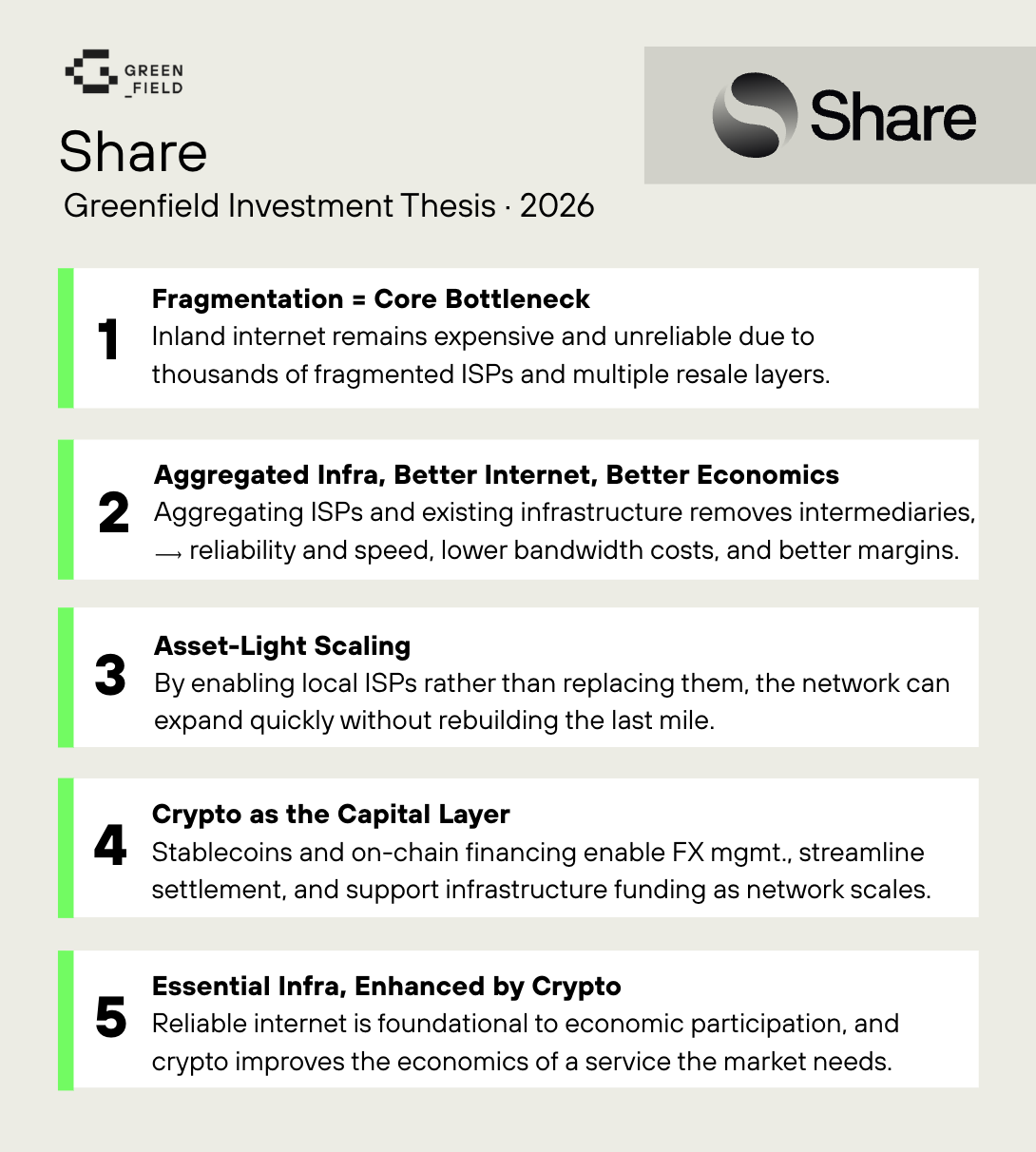
Problem: Fragmented inland distribution despite abundant coastal capacity
Over the past decade, billions of dollars have been invested in submarine cables connecting Africa to Europe, the Middle East, and Asia. Systems such as Meta’s 2Africa and Google’s Equiano now deliver massive capacity to coastal landing stations. In cities like Mombasa, global internet bandwidth is no longer scarce at the point of entry.
Yet for households and small businesses just a few kilometers inland, the internet remains expensive, unreliable, and often slow:
Africa has the world’s highest relative internet costs: broadband equals approximately 15% of monthly GNI per capita, compared to 3% globally. In some markets, households spend up to 30% of their income on connectivity. In Kenya, home internet packages range from $15 to $150 per month, while the median income is roughly $170.
In Kenya alone, there are more than 400 officially licensed ISPs. Reference calls during our diligence suggest the actual number of active operators, including hyperlocal neighborhood providers, likely exceeds 10,000. Many serve just one or two buildings. They purchase upstream capacity from larger telecom operators, resell it locally, and operate on thin margins with limited redundancy.
This fragmentation creates structural inefficiencies:
- Multiple resale layers: A household’s traffic often passes through three to five intermediary networks before reaching the global backbone, with each additional handoff adding cost and technical complexity.
- Higher effective bandwidth costs: Small ISPs purchase capacity indirectly and in small volumes, frequently paying multiples of the rate available at coastal landing stations.
- Limited redundancy and congestion: Many operators rely on a single upstream link and oversell capacity, leading to peak-hour slowdowns and neighborhood-wide outages.
- Dependency on incumbents: Large telecom groups often act as both upstream suppliers and downstream competitors, limiting smaller ISPs’ pricing power and long-term margin expansion.
As a result, growth is constrained. ISPs must pre-purchase bandwidth in fixed bundles before monetizing it. If they under-purchase, service quality deteriorates; if they over-purchase, working capital is locked up. Meanwhile, coastal capacity is abundant, yet inland distribution remains fragmented and economically inefficient.
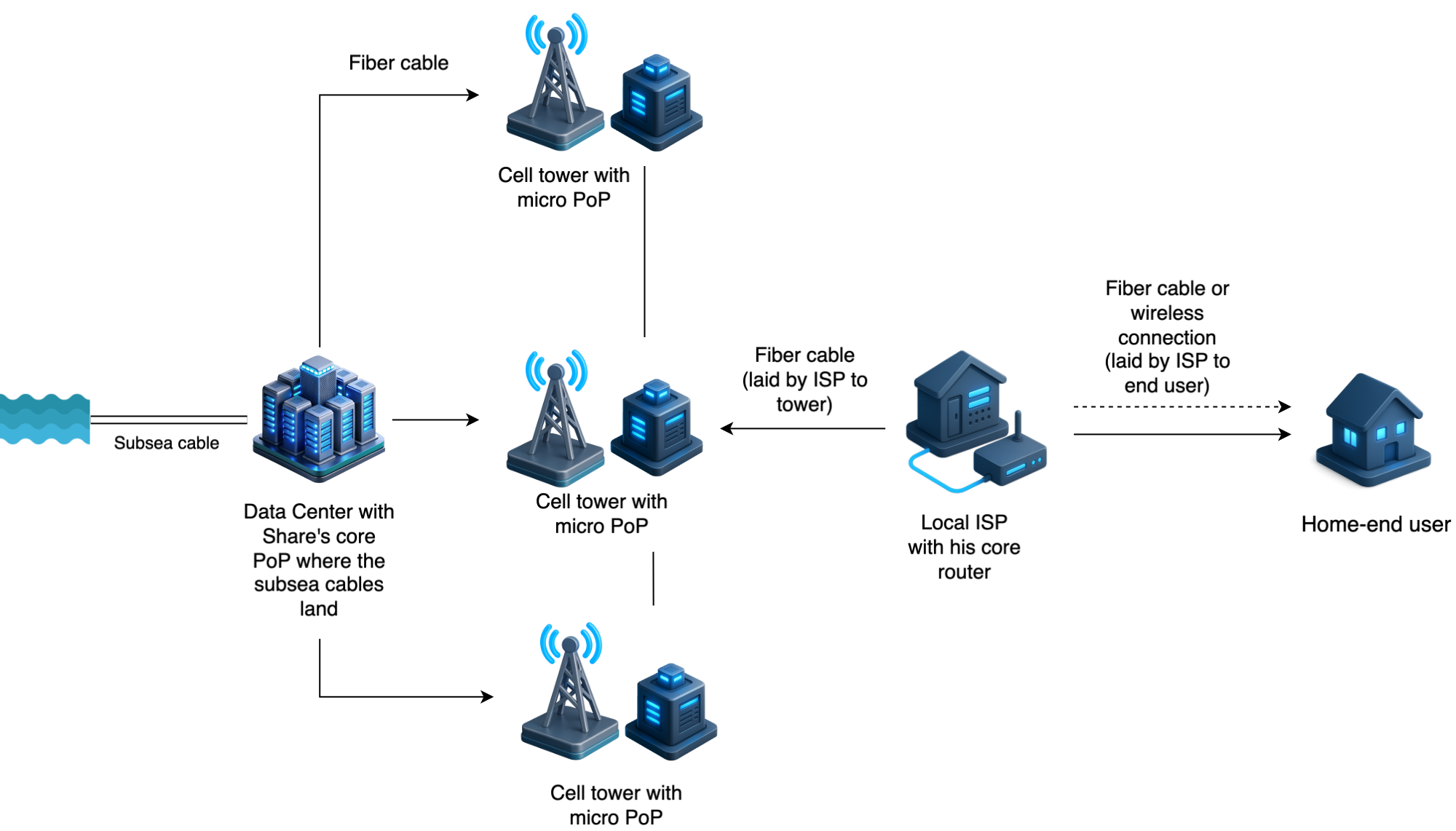
Solution: A shared backbone that aggregates and standardizes ISPs
Share addresses this structural inefficiency by building a shared infrastructure network that aggregates fragmented ISPs under a unified backbone and core network stack.
Instead of each ISP purchasing bandwidth independently and operating as an isolated network, Share connects them to a common backbone that removes intermediary resale layers and aggregates demand. This allows bandwidth to be sourced closer to coastal pricing while removing the need for small operators to pre-finance capacity in fixed bundles.
Local ISPs retain their last-mile infrastructure and customer relationships, while Share standardizes everything behind them — upstream routing, redundancy, billing, and revenue settlement — in exchange for a minority revenue share. The model creates an absorption effect: when an ISP joins, a substantial portion of its existing users migrate onto Share’s network immediately.
The model is already live in Mombasa, Kenya’s second-largest city, and is designed for replication across other dense urban markets across Africa. Share builds on three core components:
- Direct backbone access. Share establishes carrier-grade Points of Presence (PoPs) inside neutral data centers, physical network hubs that connect to submarine cables and major content networks. From there, Share interconnects directly with major content delivery networks (CDNs), including Meta, Google, Akamai, and Cloudflare, which handle the majority of global video, social media, and cloud traffic. Since CDNs and hyperscalers account for an estimated 70–80% of internet traffic, direct interconnection allows Share to localize most high-volume traffic within its own backbone, materially reducing transit costs and improving performance.
- A city-level redundant fiber ring. In Mombasa, Share has deployed more than 40 kilometers of metropolitan fiber, creating a looped backbone that automatically reroutes traffic in case of disruption. This infrastructure alone can reach approximately 1.5 million potential end users without rebuilding the last mile. Along this backbone, Share deploys compact network nodes (“micro-PoPs”) at tower sites and other strategic locations. These units connect nearby ISPs into the core network and ensure traffic flows reliably into the backbone. Importantly, Share does not scale only through new fiber deployment: by aggregating existing infrastructure through its absorption model, it can expand far beyond the fiber it builds itself without scaling capex linearly, and has already gained access to more than 1,000 kilometers of fiber across Kenya today.
- A unified software and settlement layer. Connected ISPs plug into a unified operating system that manages routing, authentication, billing, and revenue sharing. Instead of running fragmented, manual systems, ISPs gain access to a standardized digital interface for customer onboarding, internet plan creation, and payment settlement. This improves reliability, reduces operational overhead, and provides Share with visibility across the network.
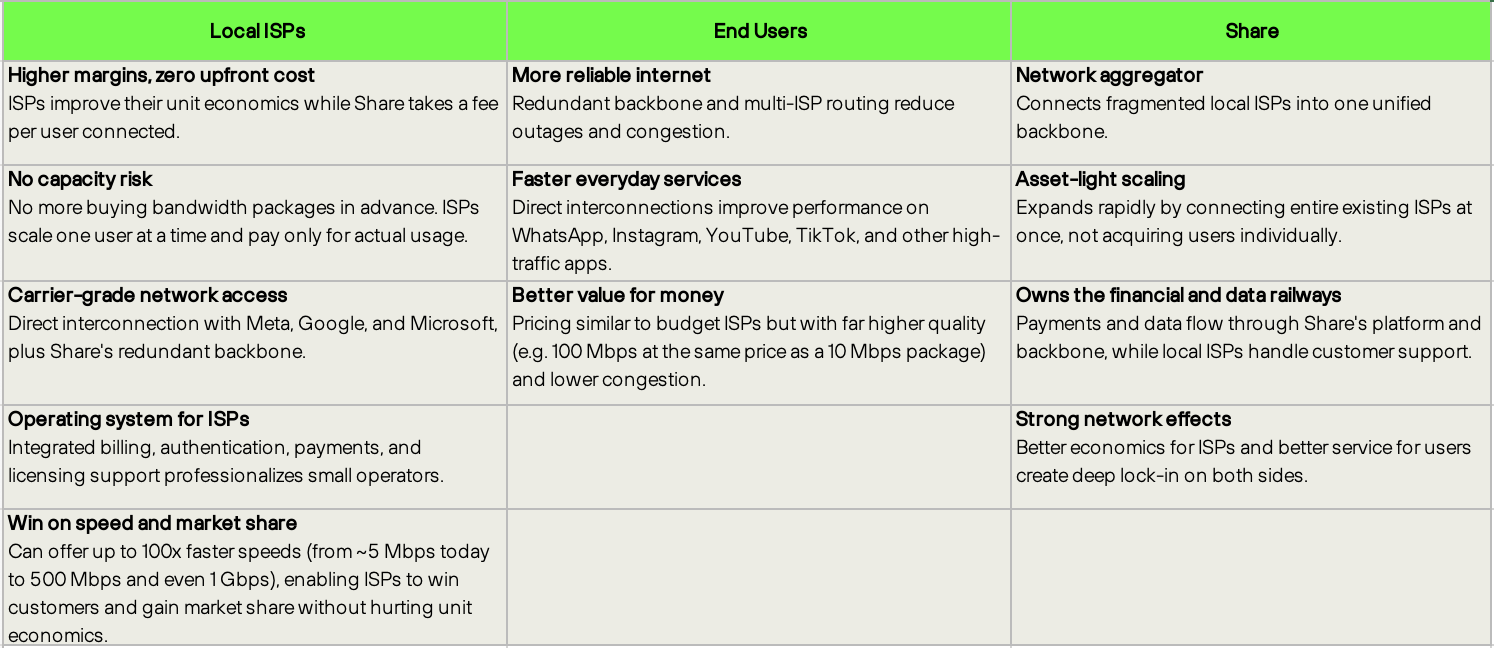
Execution has been rapid. In just over a year, Share has secured presence across nearly all of Kenya’s key carrier-grade data centers, established direct CDN interconnection, and built a growing pipeline of local ISP partners representing double-digit millions in annualized network volume.
Crypto as the capital layer
Share’s physical network (fiber, PoPs, micro-PoPs, routing, and revenue infrastructure) operates independently of crypto and generates recurring cash flows. This sequencing is deliberate.
We view Share as a DePIN infrastructure platform that builds real demand and defensible unit economics before introducing crypto-native capital mechanisms. Rather than subsidizing supply through token incentives, Share aggregates existing ISPs, absorbs live user bases, and generates predictable revenue first. Crypto is introduced only where it improves the economics of an already functioning network.
Stablecoin-based settlement addresses a practical constraint: local ISPs operate in volatile local currencies while hardware and bandwidth are often priced in USD. Standardized, programmable USD payouts reduce FX volatility, settlement delays, and cross-border friction across the network.
On-chain financing addresses a second constraint: access to affordable capital. Fiber expansion, micro-PoPs, and ISP equipment require upfront investment, while traditional financing for small operators is limited and expensive. Because Share manages routing and revenue settlement, expansion can be financed against measurable cash flows rather than unsecured balance sheets. On-chain infrastructure increases transparency around revenue flows and asset performance, reducing counterparty risk and improving capital efficiency.
This structure is particularly powerful because the network is built from standardized, revenue-generating units: Each micro-PoP functions as a compact, modular infrastructure node with predictable, location-specific revenues. As standardized aggregation points, these units can become individually financeable over time — linking physical network performance directly to programmable capital markets.
Over time, this foundation enables revenue-backed infrastructure financing, broader capital participation, and more efficient allocation of funding across a distributed network of operators. Crypto is not the product; it is a capital and coordination layer embedded within an economically viable infrastructure platform.
Infrastructure readiness meets demographic surge
Internet connectivity is foundational infrastructure. Without reliable broadband, participation in digital commerce, payments, digital services, and crypto is simply not possible.
Connectivity is one of the most powerful infrastructure multipliers for economic growth. Empirical research finds that a 10% increase in broadband penetration has been associated with roughly 1-1.5% higher GDP growth in developing economies, a material effect at the macroeconomic level, particularly in markets where long-term growth rates are often in the mid-single digits. At the same time, the growth potential remains substantial: an estimated 850 million Africans still lack internet access today, underscoring both the scale of unmet demand and the structural importance of expanding reliable connectivity. Expanding reliable internet access is therefore not merely a technological upgrade, but a structural economic accelerator.
Today, the supply side is ready: subsea capacity is abundant, networking hardware is commoditized, and software-defined infrastructure has matured. At the same time, dense urban areas are already served by thousands of local ISPs, demand exists, but coordination and capital efficiency have lagged.
Kenya combines one of the youngest and fastest-growing populations globally with accelerating digital adoption. Connectivity demand is structural. A platform that improves reliability and reduces costs can scale city by city across similar environments.
We believe this alignment of infrastructure readiness, demographic growth, and structural inefficiency creates a clear inflection point for Share.
A team of infrastructure operators, not theorists
Infrastructure businesses are defined by execution. What stood out to us in Share was how much the team had already accomplished with so little: in a short period of time and ahead of a larger financing round, they moved from concept to a live backbone, demonstrating unusual speed, cohesion, and operating discipline.
Since then, the team has deployed metropolitan fiber, secured carrier-grade data center presence, and integrated early ISP partners, all while operating in an entirely new geography. This required coordinating infrastructure rollout, tower access, data center negotiations, and local partnerships simultaneously.
Their pace and operational intensity stand out most. They are among the strongest execution-focused teams we’ve seen. They combine rapid technical deployment with disciplined local integration. In parallel, they have attracted and retained key technical talent locally and internationally, bringing in experienced engineers from companies such as Fortinet, MTN, and Huawei, as well as from some of the largest ISPs in West Africa. Their ability to align global technical expertise with on-the-ground execution gives us confidence that the model can scale beyond its first city.
Our thesis: Infrastructure first, blockchain where it matters
Zooming out, this investment reflects a broader conviction: some business models are meaningfully improved, and in certain cases only enabled, by blockchain, but only once the underlying economics work.
Share represents a blockchain-enhanced infrastructure business. It generates real market demand and growth first, then embeds crypto where it strengthens capital efficiency, settlement, and financing. In that sense, it reflects a more mature phase of DePIN: demand-first, infrastructure-backed, and built around services the market already wants.
Reliable internet is a prerequisite for participation in open digital systems. Before users can access decentralized finance, global digital markets, or programmable financial infrastructure, they need connectivity. Share builds that foundation while introducing crypto where it creates structural advantages rather than manufacturing supply through speculative incentives.
We continue to look for teams building blockchain-enhanced infrastructure systems, particularly where crypto strengthens real-world coordination and capital formation. If that sounds like what you’re building, feel free to reach out at anies@greenfieldcapital.com.