
Arcium’s $ARX Goes Live: Revisiting Our Thesis On Encrypted Compute
by Jascha Samadi and Andrzej Dzius – June 23 , 2026
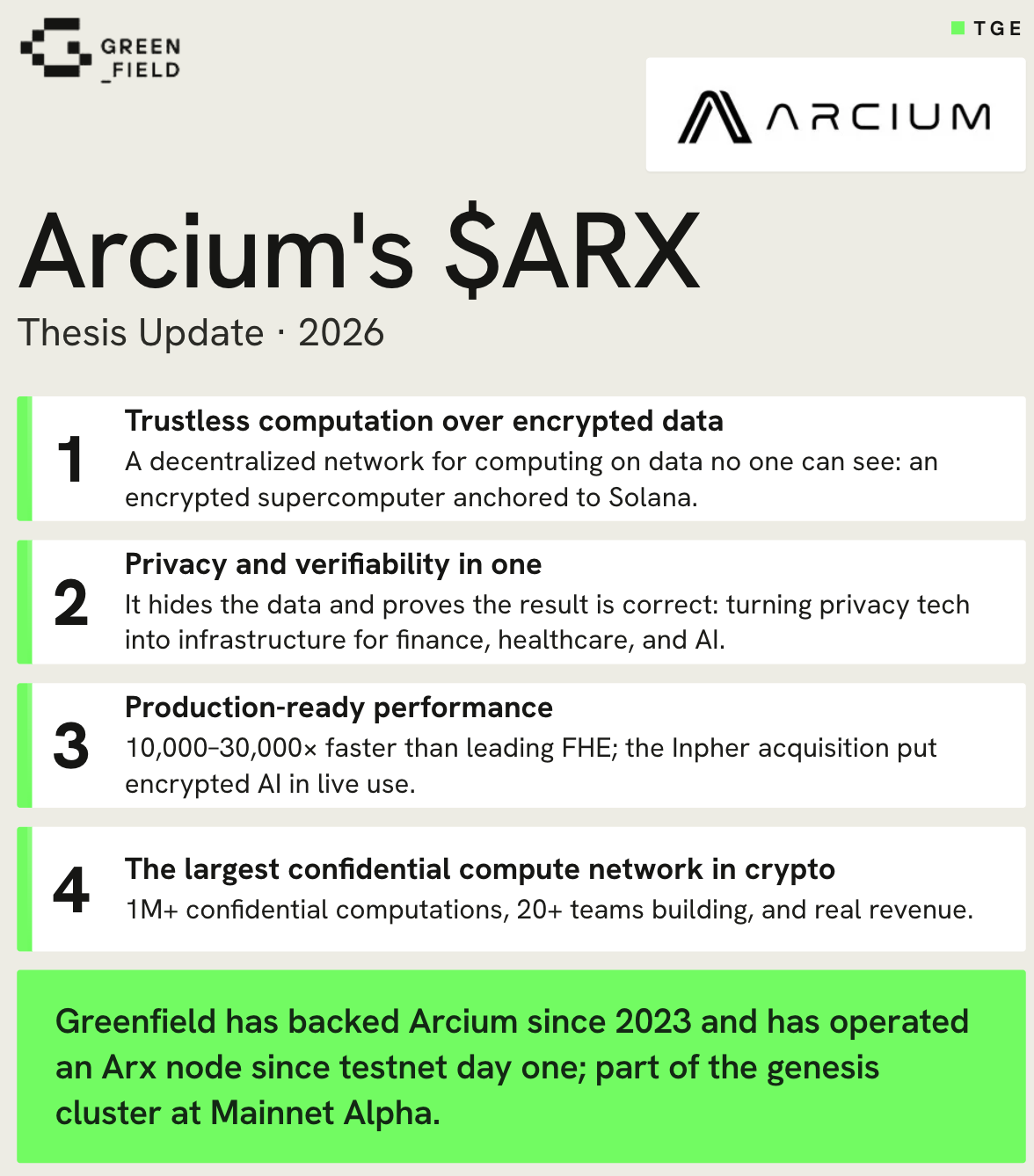
Yesterday marked an important milestone for Arcium: the network’s token, $ARX, is live, with listings on Upbit, Bitget, Coinbase, Kraken and further exchanges. Greenfield backed Arcium in 2023 and has been operating an Arx node from day one of their testnet to help the team launch its encrypted supercomputer: a decentralized network that lets anyone compute on fully encrypted data – data that no one, not even the nodes doing the computing, can see. A token launch is a good moment to step back, revisit why we invested in privacy in the first place, and explain why we believe our original thesis has not just held up, but compounded and what it means in practice to back a network like this, not just with capital, but by also operating blockchain infrastructure.
Why privacy matters
When we wrote our original investment memo, our view began with a simple observation: blockchains are public, but privacy is the norm. Privacy is a given when you pay in cash or even send a bank transfer. Nobody expects their landlord, employer, or a stranger on the street to inspect their entire financial history. Yet that is precisely the default condition of public blockchains – and it is one of the main reasons payments, institutional trading, and arguably large parts of DeFi have not scaled as they should.
Three years on, the case has only strengthened and broadened well beyond crypto. The trend in surveillance has shifted from tactical – i.e., a specific actor targeting a specific person – to strategic: collect everything, on everyone, indefinitely, and decide later what to do with it. Surveillance capitalism supplies the data; regulatory proposals like the EU’s chat control supply the legal cover; networked cameras, license plate readers, and AI-driven facial recognition supply the infrastructure. The Arcium team has been outspoken on this, framing privacy not as a feature but as a precondition of freedom.
Privacy is based on the mathematical asymmetry of encryption, which is one of the few tools that lets an individual create a secret that no amount of coercive force can undo. But Privacy alone will not win as a moral appeal. It will win when the private version of an application is simply the better product – faster to integrate, cheaper to run, and capable of things the transparent version cannot do at all.
There is a second property worth underlining: verifiability. Encrypted computation done right does not just hide data – it lets anyone mathematically verify that a computation was executed correctly, without a trusted intermediary. Privacy and verifiability arrive as a package. That combination is what turns “privacy tech” into general-purpose infrastructure for finance, healthcare, and AI – use cases well outside the scope of crypto and trading.
What Arcium is
Previously, the team had built Elusiv, a zero-knowledge (ZK)-based privacy protocol on Solana, offering private transfers and swaps, and became the most prominent first-generation privacy application in the ecosystem. But transaction privacy, as valuable as it is, addresses only a slice of the problem: it hides transfers, not computation. Encrypted shared state – i.e., many parties computing together over data that none of them can see – is the missing primitive. ZK provides isolated encrypted state, but what applications actually need is the ability to compute on everyone’s collective, fully encrypted data.
Arcium is a decentralized network for computation over fully encrypted data, anchored to Solana and powered by Cerberus, the team’s purpose-built secure multi-party computation (MPC) protocol. The architecture converges on three core principles: trustlessness, performance, and composability.
Trustlessness: Cerberus provides the strongest confidentiality and integrity guarantees available in MPC: it remains secure in the dishonest-majority setting, where all but one of the n computing nodes may be corrupted and deviate arbitrarily. For an honest participant, this amounts to zero trust in the other parties – inputs stay private and incorrect results are never accepted, no matter how many others collude. Misbehaving nodes are pinpointed and excluded, turning malicious behavior from an anonymous denial-of-service into an accountable, slashable act. On the trust axis this is a categorically stronger guarantee than honest-majority MPC designs, threshold-decryption FHE setups, or anything relying on trusted execution environments, which has an accelerating track record of hardware exploits that keeps confirming that hardware-based trust is a liability for decentralized systems.
Performance: Encrypted compute has historically been dismissed as too slow for production. Early benchmarks of Cerberus against the most efficient open-source FHE libraries showed speedups of 10k–30k x, including the preprocessing phase, which can be performed in advance, so live computation runs even faster. Arcium’s acquisition of Inpher in late 2024 – a confidential-computing pioneer backed by J.P. Morgan and Amazon – brought over 30 patents and the Manticore protocol into the stack, adding a second MPC backend optimized for ML workloads and positioning Arcium for encrypted AI. Encrypted AI is no longer a slide-deck aspiration; one of Europe’s largest hospitals is using Arcium for privacy-preserving model training and inference on real-world patient data.
Composability: Arcium does not ask developers to migrate to a separate privacy chain. It runs as an encrypted execution layer anchored to Solana (and other chains in the not-so-distant future), and with C-SPL, the Confidential SPL token standard, it brings built-in confidentiality to any token, program, or app using the familiar SPL interface: confidential balances, confidential transfers, confidential DeFi, with the developer experience Solana teams already know. The ecosystem now spans more than 20 teams building on the network.
Umbra: the first encrypted app on Arcium
Infrastructure is only as good as the applications they enable. Umbra – privacy for swaps and transfers on Solana – is one of the first major applications built entirely on top of Arcium. Since going live in March 2026, the team has shipped native mobile apps on Android and iOS, a browser extension, an SDK, and a web app that brings Umbra’s privacy guarantees to any wallet. Their first SDK integration, private vesting with Streamflow, is already live, with private payroll next on the roadmap. Umbra also demonstrates that a consumer-grade application can be built entirely on encrypted compute, with the UX of a normal app.
Running an Arx node: being part of the product
Capital alone cannot build infrastructure protocols; they must be actively operated into existence. That’s why Greenfield runs validator and node infrastructure across several protocols we have backed, including SEDA, SAFENET, NYM and others. With Arcium, the stakes are even higher than with most networks. Confidential computation is distributed across a cluster of nodes — the product only works if the operators in that cluster work. Node operators here are more than infrastructure support; they are part of the product itself.
We have operated an Arx node since the first day of Arcium’s testnet. At Mainnet Alpha, our node was part of the genesis cluster – the initial set of operators running live confidential computation on the network.
Arcium’s encrypted computation is performed by distributed Arx nodes. Operators register on-chain, declare their capabilities, and are selected into clusters that jointly execute confidential computations. No individual node in a cluster sees the underlying input data in plaintext; privacy and correctness come from the MPC protocol running across the cluster.
That architecture changes the operational model. In a standard proof-of-stake network, validators largely process the same transactions independently. If one validator drops offline for an hour, it misses rewards and the network usually continues. In Arcium, nodes inside a cluster are active participants in the same computation. A slow node increases latency for the others; a node that fails mid-computation can force a retry or cluster migration and disrupt the application relying on that computation. Uptime, response time, and completion rate are therefore critical metrics that directly dictate how the network evaluates operators, selects them into clusters, and attracts delegation. We treated the testnet node as production infrastructure. In practice, that meant continuous monitoring, proactive upgrades, incident response, and a fast feedback loop with Arcium’s engineers. This matters especially in an MPC network: when a computation behaves unexpectedly, the team needs to distinguish quickly between a protocol issue, a network issue, and an operator-specific configuration problem. Reliable operators reduce noise for the protocol team and make the network easier to harden before mainnet.
The network is no longer theoretical
When we first backed Arcium, confidential computation existed primarily as a cryptographic promise. The engineering was credible, but live networks running real applications on encrypted data were not yet a given.
That has changed. Arcium entered its TGE as the largest confidential computing network in crypto. Umbra has processed over $3M in private volume in roughly two and a half months.
Since Mainnet Alpha went live in February, the network has processed more than one million confidential computation — and we participated in all of them.
Up to the next millions.
Greenfield is an investor in Arcium and operates validator infrastructure on the Arcium network. This post is not investment advice.