
Backing Self – The leading digital identity infrastructure for the internet
by Claude Donzé – November 13, 2025
We’re excited to announce that Greenfield is leading Self’s $9M seed round alongside Startup Capital Ventures x SBI Fund (Softbank), Spearhead VC, Verda Ventures, Fireweed Ventures and various angels, including Casey Neistat, Sreeram Kannan (EigenLayer), Sandeep Nailwal (Polygon), Jill Gunter (Espresso), Jack Platts (Hypersphere), Hart Lambur (Across) and others. Self is building the open, privacy-preserving identity layer for the internet. With AI agents now acting online and transacting on-chain, the distinction between humans and machines is fading fast – the need for a solution like Self has never been more urgent.
When machines act like humans online
AI is no longer a mysterious technological advancement discussed in research labs – hundreds of millions of people interact with it daily, and algorithms get better every day. It has been the predominant topic in tech, yet few people are talking about its secondary effects thus far. One of the most immediate challenges is verifying human presence online: Social networks, comment sections – basically anywhere you go online – are swarmed with agents. Thales Cyber Security states that automated traffic accounted for over half of all internet traffic in 2024, and this is just the beginning: the next wave of AI agents will turn the internet into something unrecognizable from what it is today.
Unlike automated bots that are designed to perform narrow, predefined tasks, which became commonplace in 2024, AI agents are able to function autonomously to perform complex, independent actions (such as commenting on, interacting with, or creating social media content, including pictures and videos). Their behaviour is hard to detect and almost impossible to distinguish from that of real humans. Platforms like Meta expect agents to live on their platforms just as real humans do. X has been battling with bots for years and has recently taken measures to identify real humans better to restore authenticity and trust on their platform.
Agents browse, read, buy, sell and act on the internet like humans do. As with all technology, this can be used for good (e.g., an agent buying shoes for you based on all the context it has on you); but this can also be used for social engineering at scale (impersonating real people such as friends, colleagues, officials, convincingly, tricking victims into financial loss or personal data sharing). As agents become indistinguishable from humans in writing, voice and video, provenance and authenticity break down and will impact many of our systems. Additionally, agents will outcompete real humans across many domains ( attention, engagement, sponsorships and monetization). We believe that, on-chain in particular, agents will soon become the most profitable economic actors, especially in areas like trading and MEV, fundamentally reshaping both the online and on-chain landscapes.
Already today, identity, identity verification and authentication are large markets on the internet (~$40B globally), and with the advancement of agents, we expect those markets to grow rapidly in the coming years (~16% CAGR according to this study). Next to identifying real users, there is a strong additional regulatory push around the globe for social networks, streaming, gambling, and adult entertainment platforms to verify the age of their users, just last week, Denmark announced that they will ban social media access for under 15 year olds, the EU is working on age verification for online services under the Digital Services Act, in the United States various states have passed or proposed laws requiring age verification (e.g. Utah, Texas) and Australia’s ban for social media for under 16-year olds starts in December 2025, including platforms like Reddit.
Today, most solutions are costly and non-privacy-preserving through traditional KYC platforms. Not only do users have to share unnecessary data about themselves, but those platforms also frequently get hacked and sensitive user data is lost. Just last month, Discord appears to have lost KYC data for 77,000 users, including government IDs and photos. In early 2025, Mexican Fintech Miio lost more than 2.9 million files of sensitive user data, and in 2024 FractalID lost sensitive KYC data for 55,000 users.
It is clear to us that we need an identity solution to ensure that online spaces, social, economic and blockchain networks can tell humans from machines, preventing manipulation, fraud, and synthetic influence by indistinguishable AI agents. It must also be privacy-preserving so that verifying one’s humanity doesn’t require sacrificing anonymity or exposing personal data – protecting individuals while preserving trust in all digital interactions.
When machines transact like humans on-chain
Alongside the urgent need for proof-of-personhood solutions in Web2, there is an equally pressing demand for such systems in Web3: agents are starting to transact independently in crypto rails (e.g., through x402 standard, which enables agents to pay via stablecoin microtransactions for resources via API without registration, emails, OAuth, or complex signatures). Semantic Layer (a Greenfield investment) showcases this with 42, an on-chain arena where AI agents issue, bid, and trade assets with one another, paying each other for premium data or signals using x402. As more traditional financial transactions (payments, use of financial services, and financial products) move to blockchain infrastructure, the need for an on-chain identity solution will grow significantly in the coming years. The MEV landscape is already highly automated and competitive. However, with the increasing sophistication of AI agents, we expect it to become even more cutthroat in the coming months and years, as agents execute optimal sequencing and sandwiching strategies within milliseconds across all chains. Generally, in arbitrage and trading, AI agents will be able to identify and exploit pricing discrepancies across DEXs, bridges and perpetuals markets 24/7, not only adjusting to changing liquidity conditions in real time, but also scraping sentiment across social feeds, wallets, analyzing transaction flows and predicting short-term attention spikes before human traders even notice a pattern.
We expect agents to monitor DAO proposals, evaluate token impact, and auto-delegate votes to maximize returns or influence outcomes faster than any human token holders can – in some cases, against the best interests of the DAO itself. As AI agents can autonomously create, fund and operate thousands of wallets across multiple chains and interact with dApps intelligently, they’ll be able to execute attacks at a scale and sophistication not seen before. Agents are proving a problem for airdrops, as agentic users are becoming indistinguishable from real users, which most protocols would want to include when distributing their tokens (Vitalik advocates for leveraging zk-identity blockchain solutions for verifying user identities for airdrops). Blockchain systems are well-suited for voting, because they provide verifiable, tamper-proof and transparent recordkeeping; however, without a verifiable but private identity solution, we can’t guarantee that each vote belongs to a human and not an agent.
To us, it is clear that we need a solution to ensure trust, fairness and accountability in a world increasingly shaped by AI. Ideally, such a solution is privacy-preserving for the user, which is why we are so excited about Self.
A privacy-preserving proof of personhood
Self is addressing the outlined problems by building essential infrastructure for verifying human identity while preserving individual privacy – a Stripe for Identity. Through Self, any person can prove the most trusted attestation of who they are today – their passport or ID data – to any application (Web2 or Web3), while only revealing what the application actually needs to know, through zero-knowledge cryptography. For example, if an application needs to verify if a user is at least 18 years old, it will just get a yes or no response, based on the user’s passport data, but not all the other information (such as exact age or birthdate, name, biometrics, etc.), as it is the case with today’s approaches (which are prone to data leaks, hacks, etc.).
From everyday interactions to global systems, verifying human presence is becoming essential. Whether online or on-chain, Self enables trust in a world where humans and agents act side by side. Some hypothetical (near-future) scenarios to contextualize:
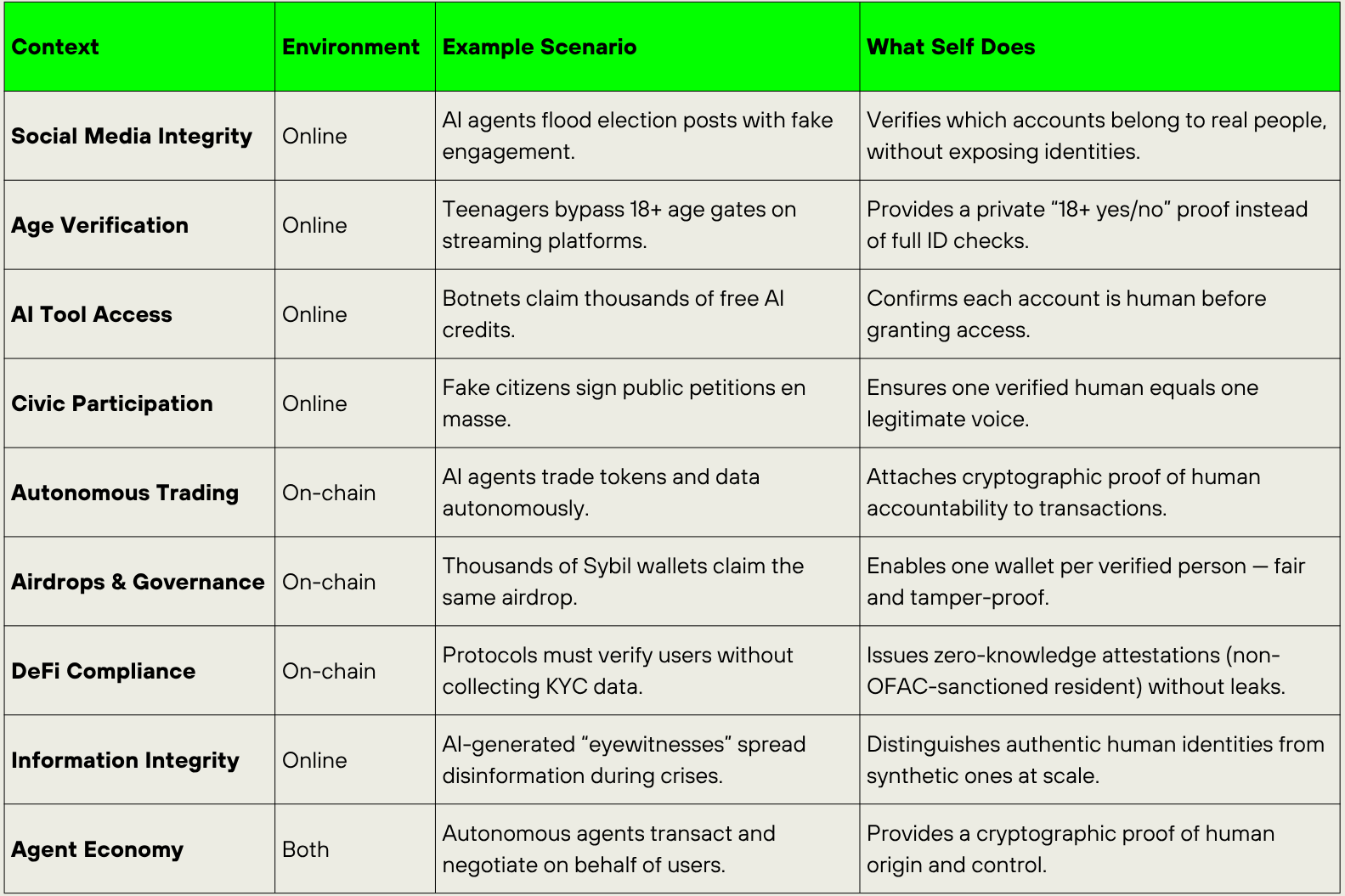
Self’s largest Web2 partner to date is Google Cloud, which utilizes Self’s solution to issue verified humans more credits and grant broader access to its AI tools (as opposed to unverified or bot users), rolling it out to millions of users. Building on this initial integration, Google is exploring further ways to integrate Self. On-chain, both AAVE and Aerodrome have launched pools only available to verified humans, paying out higher APY than non-verified users, and Espresso, building a modular, high-performance infrastructure layer for rollups, is using Self for their airdrop.
Beyond identity verification (Self Pass, powering the use cases above), Self is turning trust into utility with its second pillar, Self Connect. Connect lets users link and use their phone number as a blockchain wallet identifier, making sending and receiving digital assets as easy as texting, leveraging phone numbers, one of the largest existing social networks, to be the starting point for a new blockchain network. Users register by providing a verified identity proof (e.g., passport) through the Self Protocol; a zero-knowledge proof of identity is generated and their commitment is added to an on-chain registry. Once verified, the protocol maps the user’s phone number (or other familiar identifier) to a wallet address, enabling “phone-to-wallet” transactions with simplified UX while retaining privacy and sybil-resistance.
Launched in February this year, Self currently serves over 8 million users worldwide and supports users with either biometric passports from 129 countries or biometric IDs across 27 European Union (EU) countries, as well as Turkey, Ukraine, Vietnam, Ghana & Saudi Arabia, and recently added support for Indian Aadhaar, opening up identity verification for more than 1.4 billion potential users. Further, Self is partnering with Opera, one of the largest mobile browsers in Africa, and with Coinbase for their Base app.
Let’s talk about World
The only competitor at Self’s scale to date is World, which is following a very different approach than Self: instead of leveraging an existing attestation of someone’s identity (like a Passport or ID), World has developed a biometric-based Proof of Personhood (PoP), scanning irises through a World Orb (custom-built hardware) in physical locations across the globe. World is building their own Ethereum L2 (World Chain), with their own token ($WLD), their own wallet, their own app store, ultimately aiming to build a vertically integrated, siloed ecosystem. To date, the challenger/fraud-proof model of World Chain is not detailed; it remains unclear who runs the sequencer, whether the validator set is open/stake-based, how many validators there are, how decentralized they are and what the staking requirements are. Importantly, the collected hash of biometric data is irrevocable, creating a long-term commitment of identity to one single system. Additionally, World faces bans, legal action and investigations in several countries for collecting biometric data, such as Kenya, Spain, Hong Kong, Chile, Germany and Argentina, among others.
An open, permissionless alternative to World is crucial to prevent any single entity from monopolizing user data and access, which could lead to censorship, lock-in, strong control and a siloed ecosystem, echoing the pitfalls of today’s web2 giants. Self stands out by building an open identity layer that integrates seamlessly with any chain or application, leveraging composability and interoperability. We believe Self leveraging the most trusted attestation of who we are today, Passports and IDs, is more scalable and more accessible than World’s approach, which identifies users through hardware checkpoints.
A strong team we previously backed
Self Labs was started in early 2024 by Celo core members Marek, Rene and Eric, to provide essential infrastructure for verifying human identity while preserving individual privacy. Earlier this year, Self Labs acquired OpenPassport and welcomed Florent and Rémi to the Self co-founding team. As early backers of both Marek and Rene at Celo, we’re excited to continue to support them and the Self team in building essential infrastructure for the internet.
Engage with Self
- Self is live, available to download on the iOS App Store and the Google Play Store and ready to be integrated by developers and projects. Visit Self’s GitHub and SDK.
- Generally, learn more about Self by visiting self.xyz and for partnership inquiries, contact: team@self.xyz.
- And lastly, we’re excited to talk to you if you’re building on Self – reach out to claude@greenfieldcapital.com!