
The State of Ethereum Block Building since 2024, Part II: The Supply Side – Builder Economics and Orderflow Relationships
by Christoph Rosenmayr & Jascha Samadi – August 10, 2026
This research piece continues our Block Building series with the second half of a two-part deep dive into the state of Ethereum block building since 2024.
Overview of the series:
1. Primer: Ethereum’s Blockspace Market
2. Part I: The Demand Side – Orderflow and the Priority Fee Landscape
3. Part II: The Supply Side – Builder Economics and Orderflow Relationships (this piece)
4. The Conservation of MEV
5. Consumer Orderflow (not published yet)
Greenfield has investments in Titan’s parent company Gattaca, CoW Protocol, and NuConstruct. This analysis is based exclusively on publicly available on-chain data via Dune Analytics. The findings reflect on-chain observations and not portfolio advocacy.
Thanks to the team at Titan, Nir from Eureka labs, 0xprincess and Eto from nuConstruct and Danning Sui for their feedback and review.
Key takeaways: Part II
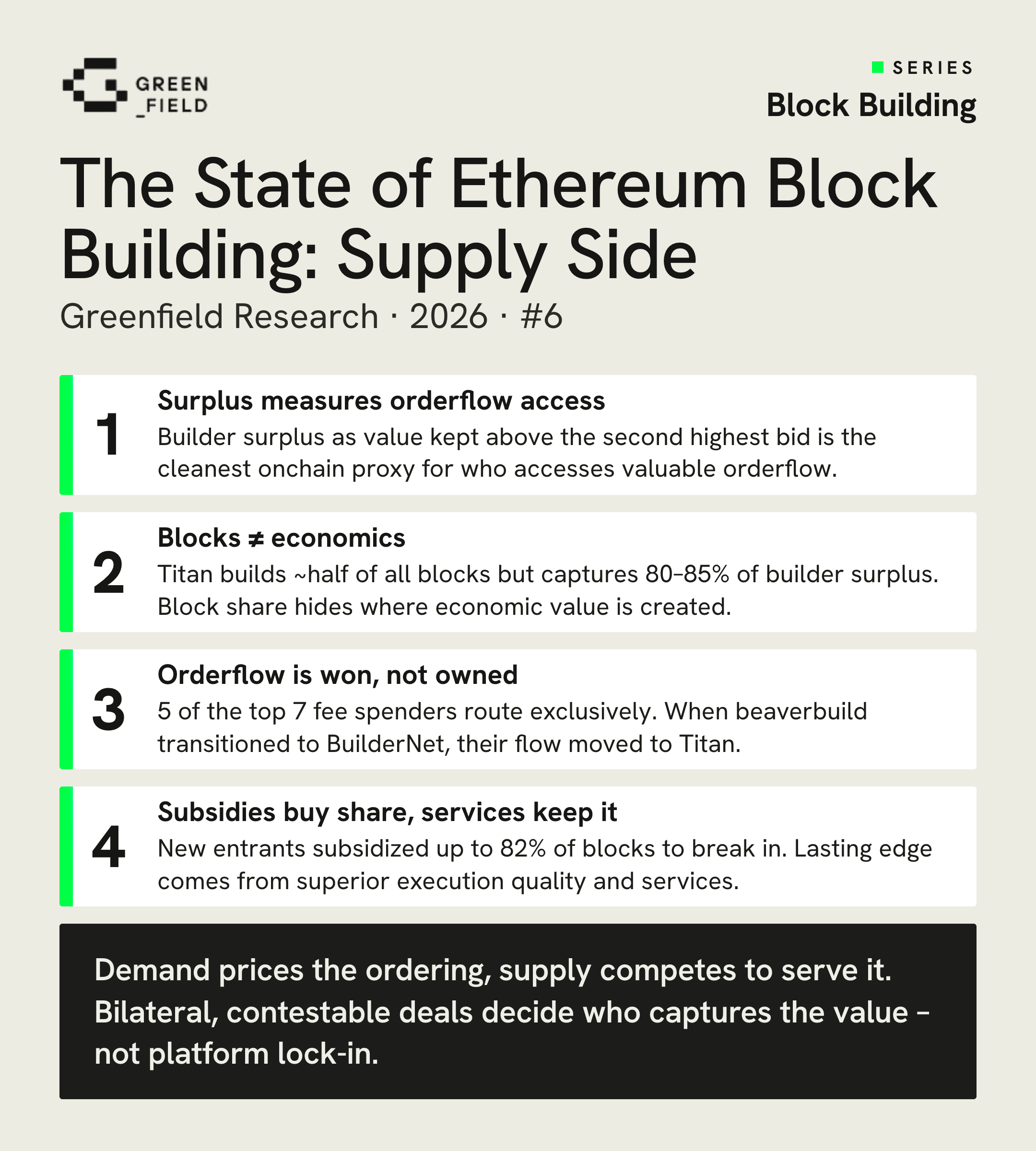
- Since the start of 2024, validators have received $1.36B in execution-layer rewards, while builders generated $404M in builder surplus, which is a proxy for access to valuable orderflow and not net builder profit as delayed priority fee refunds to orderflow providers are common.
- A view at all current and historical orderflow relationships show that the largest priority fee spenders route disproportionately to specific builders. These relationships are a key driver of block-building success, as both access to the most valuable orderflow sources and the diversity of flow received by each builder directly shape its ability to construct competitive blocks and capture builder surplus.
- We find the transition from beaverbuild to BuilderNet marking a major shift in the builder market, as beaverbuild’s orderflow deals (like jaredfromsubway or maestro) largely transitioned to preferring Titan over BuilderNet after the transition, highlighting how orderflow providers will migrate when another builder can better satisfy their needs around execution quality, latency, reliability, and custom services.
- Builder surplus reveals market structure more clearly than raw block share. As a result the transition Titan currently builds roughly half of blocks but accounts for 80-85% of builder surplus, showing that the most valuable orderflow is not evenly distributed across builders. Leading to Titan also having the highest average builder profit retention ratio of above 80%.
- Builders employ distinct market-share strategies, balancing profitable, zero-profit, and subsidy blocks. As a result, winning more blocks does not necessarily imply generating more builder surplus.
- Block value is heavily front-loaded. Most priority fees are paid near the top of the block, consistent with MEV strategies requiring priority access to state. Builder-specific differences in block-position priority fees further show how orderflow composition shapes the block construction competition.
- All data can be found in this Dune dashboard and will be maintained going forward to provide ongoing insights into the Ethereum Orderflow landscape.
Introduction
This article is the second installment of our two-part analysis of block building economics. In Part I, we examined the demand side of the market: who generates valuable orderflow, why different actors pay for priority, and how priority fee demand varies across users, wallets, applications, solvers, and MEV searchers and gain an overview of the priority fee market on Ethereum.
With that foundation established, Part II turns to the supply side of the market: block builders. The central question is how builders compete to access, serve, and monetize this increasingly specialized orderflow. And how access to valuable orderflow shapes the block production competition by deciding how value is distributed across Ethereum’s block production stack.
Readers seeking a broader introduction to the market structure and key participants may also find our block building primer helpful as a supplementary background.
Our analysis is based solely on fully observable on-chain data, all of which can be found in this Dune dashboard and can be used to generate additional insights beyond what will be highlighted in this article. We aim to make the data forward-maintainable to provide insights into future changes in market structure.
Other important factors impacting the competitiveness of block builders, like latency differences or relay policies, are out of scope here.
Block builders surplus landscape
So far, we have looked at the concentrated nature of the priority fee landscape, driven by MEV-related priority fee spend, with a few unique players dominating their respective categories.
We now aim to understand how this shapes the block building competition, which is about accessing and monetizing this concentrated high-value orderflow in order to produce the highest valued block per slot.
We start with Surplus & Subsidy in an attempt to understand the market more deeply than looking at % of blocks built market share statistics, and then move to a more granular view of how orderflow providers and builders interact.
Validator Execution Layer (EL) rewards are the total block value the validator receives by outsourcing block construction to block builders via MEV-Boost.
Builder surplus is the value retained by the block builder address inside the block and is calculated via native ETH balance changes in builder address between before the first txs vs after the last txs in a block. As the last transaction in MEV-Boost blocks are proposer payments for the won block a positive builder surplus indicates a higher block value than validator EL reward/payout. For example a builder constructs a block worth 1 ETH and pays the validator 0.9 ETH, the remaining 0.1 ETH appears as builder surplus.
However, builder surplus should not be interpreted as net builder profits as it measures how much value remains with builder-controlled addresses immediately after the block, before any delayed refunds/rebates as we have described above via priority fee refund RPCs or other direct builder orderflow refund systems, which are difficult to attribute and measure on-chain.
Considering this caveat we still see this as an insightful metric to understand which builders are accessing valuable orderflow percentage of blocks built market share statistics cant reveal in the existence of subsidy (=negative builder surplus) as well as an upper bound of true net builder profits after paying all refunds to all orderflow providers.
We see validators receiving a cumulative of $1.36B in EL rewards with builders taking $400M in builder surplus (builder surplus equal to 29.4% of validator EL rewards) since the start of 2024 (bottom left). The builder surplus ratio has been increasing since the start of 2026 to above 35% in many recent weeks (top right). Given validators receive the auction-clearing bid for each block, builder surplus represents the residual value the winning builder can retain because it was able to construct a block more valuable than the next-best competing bid, which is the edge over the competition and increasingly rebated to orderflow providers rather than value taken from validators.
Titan and beaverbuild are the leading block builder surplus with a cumulative of $211M and $111M, respectively (bottom right) indicating that they were historically able to access the most valuable orderflow.
By manually deselecting (excluding) Titan and beaverbuild in the Dune dashboard, we see the long tail of builders clustering near 0 builder surplus with outliers like BTCS builder with surplus of -$1.85M (subsidy), bobTheBuilder steadily increasing surplus at a constant rate to $6.9M, and mevrefund with strong outlier surplus (whitehat MEV) as well as rsync (wintermute) occupying the third spot by surplus but having ceased operations since December 2025.
When plotting the per-week builder surplus market share (top), we see a different picture from the raw % of blocks built market share. Titan (orange) currently accounts for roughly 80-85% of total builder surplus, despite building closer to half of blocks. We also see beaverbuild’s decline following the transition to BuilderNet, including a sustained period of negative builder surplus (=subsidy), which we cover in the next section. In recent months, bobTheBuilder and the BuilderNet instances have been competing for second place by builder surplus after Titan.
Given that builder surplus captures economic outcomes more directly than raw block share, as a proxy for access to high value orderflow Titan’s current position is highly noteworthy as access to valuable orderflow seems more concentrated than block production itself.
The bottom chart shows the 7-day average builder surplus ratio, defined as builder surplus divided by validator EL rewards, for selected builders. We manually remove March 12-13 for Titan to exclude the outlier $34M surplus event caused by the AAVE frontend swapper’s incorrect input, as we are interested in average behavior rather than one-off extreme events.
Titan (dark blue) again emerges as an outlier, with a surplus ratio above 80% up from 30% in mid 2025, compared to roughly 20% for most other builders. This indicates that Titan currently generates significantly more builder surplus relative to validator EL rewards, consistent with stronger access to high-value orderflow and ability to outperform the 2nd highest bidder in the auction. Changes to builder surplus ratio overtime can help indicate whether certain builders are losing or onboarding new high value orderflow providers.
Block builders subsidy landscape
As mentioned above, block builders are subsidizing blocks (negative surplus) by paying more than the block is worth, in order to win market share.
This is a common occurrence as block builders need a strong market share to provide stronger inclusion guarantees to their orderflow providers and onboard new ones. Even today’s dominant builders like Titan were subsidy-heavy in the past (not shown) in order to gain market share and managed to monetize this market share later.
We split blocks into three categories: Profitable blocks (surplus), Subsidy blocks (negative surplus), and Zero profit blocks (less than 50 cent surplus). We see in recent months that above 80% of blocks are profitable, which is a considerable shift from the subsidy-heavy regime around September 2025, where 70-82% of blocks were subsidized.
We can also see the share of zero-profit blocks rising considerably in recent months. This seems to be mainly driven by the rise of Quasar, with a strategy of specifically targeting/producing zero profit blocks, holding a 70% share of landing/winning zero profit blocks, which contributed to their recent growth in market share. With Titan fully ceasing to compete for zero profit blocks in the last 4 weeks.
When looking at notional USD spent as subsidy (top), we can see a subsidy-heavy regime starting mid 2025 and ending early 2026, with two distinct peaks. Initially, Quasar (dark pink) started subsidizing (peak of 50% of subsidy spent), followed by the BuilderNet instances joining, which prompted Titan (yellow) to increase subsidy spending.
The second peak in subsidy spending was driven by BuilderNet (Flashbots), specifically contributing 60-85% of total subsidy spent, which is still roughly the case with lower overall total USD spent on subsidy. Despite (or because of) its strong market position, Titan is not spending on subsidies currently. Both Quasar and BuilderNet were new entrants into the market at the time, using subsidy spend to win more blocks to onboard more orderflow providers and monetize this orderflow later.
The top chart shows the percentage of a builder’s won blocks being subsidy blocks. We see an array of longer tail builders attempting to gain market share via subsidy spend (which don’t show up in notional graphs above due to their low market share of blocks built), like bananabuild (unrelated to Banana Gun), shimmerblocks, bombora. build, iobuilder, boba-builder, and hello block, which all lead these statistics during different periods.
The bottom chart shows the average USD spent per subsidy block (total subsidy spent / number of subsidy blocks). While the average spent per subsidy per block is very low for many builders like Quasar, Titan, or BuilderNet (Beaver), averaging $1-8 per subsidy block, especially BuilderNet (Flashbots) seems to have a highly inefficient strategy of often paying upwards of $100 on average per subsidy block.
However, since we defined subsidy spend as negative profits, it could also be that BuilderNet TEE-based architecture, which leads to higher latency, can cause negative profits if bids are not adjusted down in time before the auction cutoff at the arrival of new information which decreases the true block value (adverse selection), which could explain the inefficient subsidy average subsidy spend per block across the BuilderNet instances.
However, as the three BuilderNet instances share access to orderflow and have similar latency disadvantages to other builders, we still see Nethermind’s and Beaver’s BuilderNet instances managing a more efficient subsidy strategy, resulting in a similar result of 4-6% of their blocks being subsidy blocks while spending a fraction of BuilderNet (Flashbots) on subsidy.
This difference in subsidy strategy helps explain the differences in BuilderNet instances in cumulative builder surplus and builder surplus ratio.
Builder-Orderflow relationships
We now aim to understand how the routing of valuable orderflow from orderflow providers to select block builders and their respective relationships creates the builder market outcomes we have observed so far.
Besides public (mempool) and private orderflow sent privately to many builders, exclusive orderflow is usually routed/sent to one specific builder by the orderflow originator via the Builder RPC.
Access to unique orderflow and its associated priority fees is of huge importance for block builders, as builder surplus and margins for transactions shared by many builders get quickly competed away in an efficient block auction. While exclusive orderflow lets builders retain excess surplus by building more valuable blocks with transactions their competition doesn’t have, while still only marginally outbidding the competition in the block auction to retain the spread as surplus of which block builders send refunds to orderflow providers and likely keep a cut as revenue. Previous research using a proprietary dataset of proposed blocks obtained from a relay found 85% of the value in winning blocks comes from exclusive transactions.
For orderflow providers such as searchers or applications, the benefits of sending exclusively to one party are less information leakage via increased strategy secrecy, exact ordering constraints, or conditional execution, as well as priority fee kickbacks/refunds when overpaying due to lack of information in the blind bundle auction.
These relationships arise as there is demand for additional services that is not satisfied within the current MEV-Boost framework, as in the absence of a shared protocol-level marketplace for those guarantees, these requirements are handled through bilateral relationships with builders. See this paper for further information on the mechanics of exclusive orderflow.
We again show the highest 30-day priority fee spending addresses, but also group by the builders’ blocks in which these priority fees were paid and remove outliers by only including priority fee spenders which are in the top 250 spenders since 2024.
The relative breakdown (bottom) reveals what % of total priority fees per spender address were spent in a certain builders block. While there is no bulletproof way to spot exclusive orderflow relationships from on-chain data, we can make estimations by comparing the breakdown of priority fees by builder to the raw percentage of blocks built by builder in the 30-day period, which would represent a normal distribution if the odds of landing in a certain builder’s blocks are completely uniform and just depending on market share. Of course, even besides exclusive relationships, there are strategy differences that cause slight deviations e.g., Quasar or BuilderNet being more subsidy and zero profit block heavy.
Given Titan held a roughly 50% market share by blocks built during the time of writing, any distribution of priority fees spent in builder blocks deviating strongly from 50% in Titan blocks is a good indication of an exclusive orderflow relationship.
Out of the top 7 largest priority fee spenders (which account for the majority of priority fee spend), we can estimate 5 exclusive orderflow relationships. 4 of which (0xbdb (stat arb searcher mentioned above), Maestro Telegram Bot, Wintermute, Banana Gun Telegram Bot) seem to be sending their transactions exclusively to Titan.
With 0x01FD (5th largest) sending exclusively to bobTheBuilder (potentially being operated by the same team). 0x01FD is the previously described sandwich contract (2nd largest by priority fees among sandwich MEV) in heavy competition with jaredfromsubway and appears to pass on all sandwich profits to bobTheBuilder, which hints at vertical integration. This flow increases bobTheBuilders bidding power and ability to win blocks, since all sandwich profits are effectively being converted into bidding power.
jaredfromsubway is the main exception out of the top 7, being the largest priority fee spender over the last 30 days but seemingly sending to all builders roughly equally (more on this below).
This confirms that the majority of major priority fee spenders (and therefore block value) are already engaged in exclusive deals with block builders.
Out of the top 50 highest priority fee spenders, Titan seems to have the highest number of exclusive partnerships with 12 orderflow sources, which are landing above 75% of their priority fee spend in Titan blocks used as criteria. Besides Titan, bobTheBuilder seems to have 3 orderflow partnerships, with BuilderNet seemingly only having one agreement with SCP which is routing orderflow from both their solver and stat arb contracts. And other builders seemingly do not have exclusive agreements in place.
This shows the % contribution of different orderflow sources to total priority fee in different builders’ blocks over the last 30 days. This aims to highlight the most important orderflow sources per builder. For example, 0xbdb contributes 18% to Titans’ total block value while only contributing roughly 3-6% to the BuilderNet instances block value.
By manually selecting different builders in the Dune dashboard, we can get a sense of the distribution of orderflow sources for different builders and how important they are to them by showing what % of their block value can be attributed to priority fees coming from a certain source. Hovering over the bars in Dune with showcase orderflow labels.
We see Titan having the most normally distributed contribution of different sources as a result of their higher number of exclusive orderflow relationships. Which leads them to be able to build higher value average blocks, which explains why jaredfromsubway is sending flow equally to all builders, contributing above 21% to the other builders blocks but only 14% to Titans block value as they have other high value orderflow sources as well.
To make builder-level orderflow differences between builders easier to compare, we normalize each builder’s last-30-day priority fee value to 100% and break it down by contributing orderflow source, which highlights how diversified a builder’s orderflow sources are. We see jaredfromsubway (red) not sending flow to smaller builders like Eureka and bobTheBuilder as well as exclusive flow which doesn’t show up in other builders bars.
Orderflow relationships are changing over time
Above, we have highlighted current orderflow relationships existing in the last 30 days. Understanding how orderflow relationships have evolved over time provides key insights into the competitive offering of different builders towards orderflow providers.
In the dune dashboard, the “Manual orderflow relationship checker” allows you to select any spender_address and start date to see how both its notional priority fees as well as distribution in different builders blocks (%) have changed over time. As inspiration for important addresses to check, we provide the highest priority fee spender starting from a select time period.
We look at 4 examples of large (regular) priority fee spender which had interesting changes in their orderflow relationships with different builders.
1. This shows one of SCP’s (beaverbuild) stat arb contracts, which, until the transition from beaverbuild to BuilderNet, they sent exclusively to beaverbuild (their vertically integrated builder), which was part of their competitive advantage. After the transition of beaverbuild to BuilderNet, they have transitioned to only sending to BuilderNet, which has coincided with their contracts’ decline in market share for stat arb priority fees we have shown above. Their 2nd stat arb contract, which stopped operating in late December 2025, shows the same pattern.
2. We show jaredfromsubway new main contract, who initially had an exclusive relationship with Beaverbuild (yellow), but didn’t move to sending only to BuilderNet after the transition, and is now sending equally to all builders, reflecting their market share.
3. This shows Wintermute’s main stat arb contract. They were initially sending mainly to their own builder rsync, followed by a short period of sending to most builders equally after moving to a likely exclusive relationship with Titan (dark blue) around November 2025.
4. Lastly, the Maestro telegram bot routes trades on its users’ behalf. Initially, there was a preference for sending orderflow to beaverbuild, which they migrated to BuilderNet; however, since roughly 02-2026, they have transitioned to preferring Titan (dark blue) to land their users’ trades.
Besides these large and very regular priority fee spenders, we highlight a few exclusive relationships between longer tail priority fee spenders and long tail builders; in some cases, the same team might operate both parties. MEV Frontrunner Yoink has been landing transactions very frequently in “I can haz block?” blocks. IBribe2Much has been landing frequently in this builder’s blocks: 0x3bee5122e2a2fbe11287aafb0cb918e22abb5436 as well as 0xc0ffeebabe, recently having switched to bobTheBuilder.xyz. This highlights that exclusive relationships exist throughout the market, with longer tail builders, however, relying on a few highly concentrated irregular priority fee paying searchers rather than the larger more regular orderflow sources of large builders.
Impacts of beaverbuild to BuilderNet transition
1 year ago, beaverbuild announced retiring their centralized builder (tied with Titan at 40% market share each at the time) and fully moving to running a BuilderNet instance as well as transitioning their orderflow relationships to BuilderNet.
BuilderNet aims to decentralize blockbuilding via different TEE instances sharing access to orderflow and competing mainly on block-building algorithms in the future. More on their stated goals here.
This transition has been the most important inflection point in the builder market in recent years, as reflected in many builder market outcomes we have shown so far. While its goals are commendable, it seems that BuilderNet’s technical limitations, such as having to run vanilla Flashbots builder code without the ability to incorporate proprietary optimizations and services or potential latency differences, have turned many orderflow providers away from using the service.
This can be seen by most of Beaverbuilds ‘ orderflow sources either transitioning to working with Titan (maestro) or sending to all builders equally (jaredfromsubway) instead of working with BuilderNet exclusively as hoped from the orderflow transition. The orderflow providers that decided to stick with BuilderNet, such as SCP stat arb contract, have seen drastic decreases in their respective competitiveness compared to their competitors now working with Titan exclusively (Wintermute). It also seems Beaverbuild has even stopped operating their BuilderNet instance by now.
By removing the main counterbalance of the previous duopoly (beaverbuild & Titan) and replacing it with service deemed inferior by orderflow providers, this transition has massively strengthened Titan’s market position by allowing them to capture the key orderflow relationships, which leads to higher block values and surplus, of which they currently capture 85% (of total builder surplus).
Non MEV (consumer) orderflow relationships
Here we look at only spenders, not labeled MEV (or token smart contracts), and their orderflow relationships to different builders. These are handling orderflow for consumers directly and only in some cases have direct control over which builder to choose for landing trades (if they control the users’ RPC).
Re-using the above-defined classification, we again see the two telegram bots (Maestro & Banana Gun) both landing above 75% of total priority fees in Titans blocks, indicating a preference for Titans services for landing their users’ trades, while SCP’s UniswapX solver is sending exclusively to BuilderNet.
We will dedicate a separate follow-up research to consumer orderflow dynamics and the monetization opportunities for consumer applications resulting from the ability to secure exclusive relationships with builders to land their users’ trades.
As we have mentioned above, certain consumer applications also seem to be leveraging Refund RPCs/OFAs to recapture the priority fees spent by their users.
Block index position insights
Lastly, we look at priority fee statistics per relative position in the block per builder for the last 30 days in May 2026. Where 0 is the top of the block (first txs), and 100 is the bottom of the block (last txs). This helps us understand how the composition of orderflow sources we looked at previously shaped blocks by different builders.
The top shows the percentage of total priority fees being contributed by transaction in a certain position in the block. And at the bottom, the cumulative percentage per block builder.
We see how most priority fees are being paid at the top of the block, with the top 5% (earliest in the block) contributing 65-35% and the top 25% transaction contributing 87-66% of total priority fees to different builder blocks. This aligns with our earlier data showing how regular priority fees come from MEV, specifically stat arb, which relies on being first to touch the state in a specific pool, therefore requires top-of-block placement. We can also see outliers in the middle of the block as well as at the bottom of the block.
By manually selecting different builders in the Dune dashboard, we see different distributions by builder. For example, Quasar is especially efficient at building blocks with high priority fees at the bottom of the block, compared to the BuilderNet instances or bobTheBuilder, which have a higher percentage contribution from transactions at the top of the block.
We examine the median priority fee per block position to remove high priority fee outliers. This helps us understand what the typical (median) transaction pays in a certain index position.
We still see a top-of-block median priority fee dominance, with, however, a smoother decay compared to above, highlighting that even at the top of the block, the first few transactions are more outlier-heavy. Given the almost non-existent median priority fee for the middle or bottom of the block, we see these as very outlier-driven, more so than the top of the block.
The relative breakdown of median priority fees per block position per builder (bottom) gives an insight into competitive advantages for different builders, which is shaped by their unique access to orderflow sources.
Disregarding the absolute first (0) position due to builders like Titan and Quasar providing a service of unlocking AngstromDEX pools (non-contingent state) for a low fee, we see Titan (yellow) leading by having the highest median priority fee for the top 35% of the block (TOB). While the distribution is similar across builders, as this part of the block has the highest median priority fees, even small advantages of higher median priority fees compound into building much more valuable blocks than the competition. The BuilderNet instances then lead for the top 35-60% of the block, mainly at the expense of Eureka, before we again see Titan having much higher median priority fee (up to x10 higher) than the competition for the bottom of the block (however, from a much lower average notional priority fee at this position).
Forward-looking builder market changes
While we primarily focused on observable on-chain market structure today, we have described how demand for richer transaction preferences and conditional/custom execution requirements have led to exclusive bilateral relationships between large orderflow providers and block builders.
While a full exploration of these topics is out of scope, we see a few promising ideas combining these ideas to provide additional services to orderflow providers to improve market structure and efficiency.
Relay block merging is a new idea to extend the role of the relay to append and merge non-conflicting transactions only seen exclusively by a losing builder, onto the winning block. This allows for a more cooperative construction of blocks, with specialization on different parts of the block being possible, as well as reducing fragmentation from exclusive orderflow and increasing block utilization. It also allows individual builders to offer more expressive services to orderflow providers, such as inclusion preconfirmations or other constraints, without requiring full builder integration, as the preconfirmed transaction can be merged with the winning block.
TOOL by NuConstruct lets proposers opt to have their blocks divided into sub-slots of 200ms – 1s after which a state transition is shared, allowing the following transaction to build on the updated state rather than the stale state from 12 seconds ago. This gives orderflow providers much faster execution confirmations as well as conditional/custom execution constraints.
EurekaLabs with Builder Execution Extensions/Oracle aim to turn the block builder into a live execution environment by moving expensive on-chain calculations into the builder’s simulation environment and simulating via fresher mid-block state. This could allow entirely new applications or MEV strategies to come on-chain that were previously unfeasible on the Ethereum mainnet, such as propAMMs or JIT on-chain routing. This concept is similar to Titan’s pAMM, where propAMM oracle prices are continuously updated via an in-memory builder block state as a specialized version of a similar idea.
Conclusion: The state of Ethereum block building
The builder market is shaped by missing protocol functionality
Ethereum block building is increasingly a market for serving sophisticated orderflow providers rather than simply assembling blocks. The highest-value orderflow sources predominantly MEV searchers such as Wintermute and jaredfromsubway require functionality that MEV-Boost’s blind bundle auction cannot provide, including custom execution, conditional logic, privacy, latency guarantees, rebates, and preconfirmations. In the absence of protocol-level support, these services are negotiated directly with builders. The data suggests this has already become the dominant market structure, with a large share of valuable orderflow routed through exclusive or highly preferential builder relationships.
Block builder layer enabling innovation
Competitive pressures and the importance of being high quality service providers to orderflow providers forces builders to invest in better infrastructure and new execution primitives, from preconfirmations and application-controlled execution to builder oracles, pAMMs, and other emerging designs. Builders are not only capturing value, they are also facilitating and funding much of the innovation happening at Ethereum’s execution layer, which we expect to continue and accelerate in the coming year.
The beaverbuild → BuilderNet transition as case study
The transition from beaverbuild to BuilderNet was the clearest demonstration of this dynamic. While BuilderNet aimed to decentralize block building through shared orderflow access, it failed to retain much of the valuable flow that had made beaverbuild competitive. Major sources such as Maestro and Wintermute migrated to Titan, suggesting that orderflow providers value differentiated execution quality, custom optimizations, and low-latency services more than shared infrastructure alone. The lesson is simple: when builders stop meeting the needs of sophisticated orderflow providers, the flow moves elsewhere.
Network effects are bilateral, not platform-wide and relationships contested
Block building does not behave like a traditional two-sided platform. Instead, value accrues through bilateral relationships between builders and orderflow providers. This explains why Titan wins roughly half of blocks but captures 80-85% of builder surplus: the most valuable orderflow is not distributed evenly across the market.
However as we have seen with the migration of orderflow once their demand could be better matched by a different block builder and the ongoing initiatives to provide better services to attract orderflow providers this should not be interpreted as evidence of permanent market power. Block builders are not able to lock orderflow providers into a platform, rather each orderflow relationship has to be won and continuously maintained through execution quality, reliability, privacy guarantees, custom transaction handling, and other valued added services.
Orderflow relationships should not be interpreted as static backroom arrangements or evidence of permanent capture. Relationships are repeatedly changed when another builder offers better services. As relationships are bilateral and contestable, this is the opposite of a platform monopoly and the builders that best serve sophisticated orderflow providers on an ongoing basis will continue to capture a disproportionate share of value.
If you have feedback or are interested in these topics, feel free to reach out on Telegram (https://telegram.me/@thirdeye33) or email (christoph@greenfieldcapital.com).
All charts and underlying queries can be found in this Dune dashboard and will be maintained going forward to provide ongoing insights into market structure changes.
Greenfield has investments in Titan’s parent company, Gattaca, CoW Protocol and NuConstruct. This analysis is based exclusively on publicly available on-chain data via Dune Analytics. The findings reflect on-chain observations and independent research views, not portfolio advocacy or investment advice.
The analysis may reference projects, protocols, builders, searchers, and market participants in which Greenfield may have a direct or indirect interest. Any such references are for research and informational purposes only and should not be interpreted as endorsements, recommendations, or representations of future performance.