
The State of Ethereum Block Building since 2024, Part I: The Demand Side – Orderflow and the Priority Fee Landscape
by Christoph Rosenmayr & Jascha Samadi – August 6, 2026
Who actually pays for priority on Ethereum? This research piece continues our Block Building series with the first half of a two-part deep dive into the state of Ethereum block building since 2024.
Overview of the series:
1. Primer: Ethereum’s Blockspace Market
2. Part I: The Demand Side – Orderflow and the Priority Fee Landscape (this piece)
3. Part II: The Supply Side – Builder Economics and Orderflow Relationships
4. Consumer Orderflow (not published yet)
5. The Conservation of MEV (not published yet)
–> See also the accompanying Dune dashboard
Greenfield has investments in Titan’s parent company Gattaca, CoW Protocol, and NuConstruct. This analysis is based exclusively on publicly available on-chain data via Dune Analytics. The findings reflect on-chain observations and not portfolio advocacy.
Thanks to the team at Titan, Nir from Eureka labs, 0xprincess and Eto from nuConstruct and Danning Sui for their feedback and review.
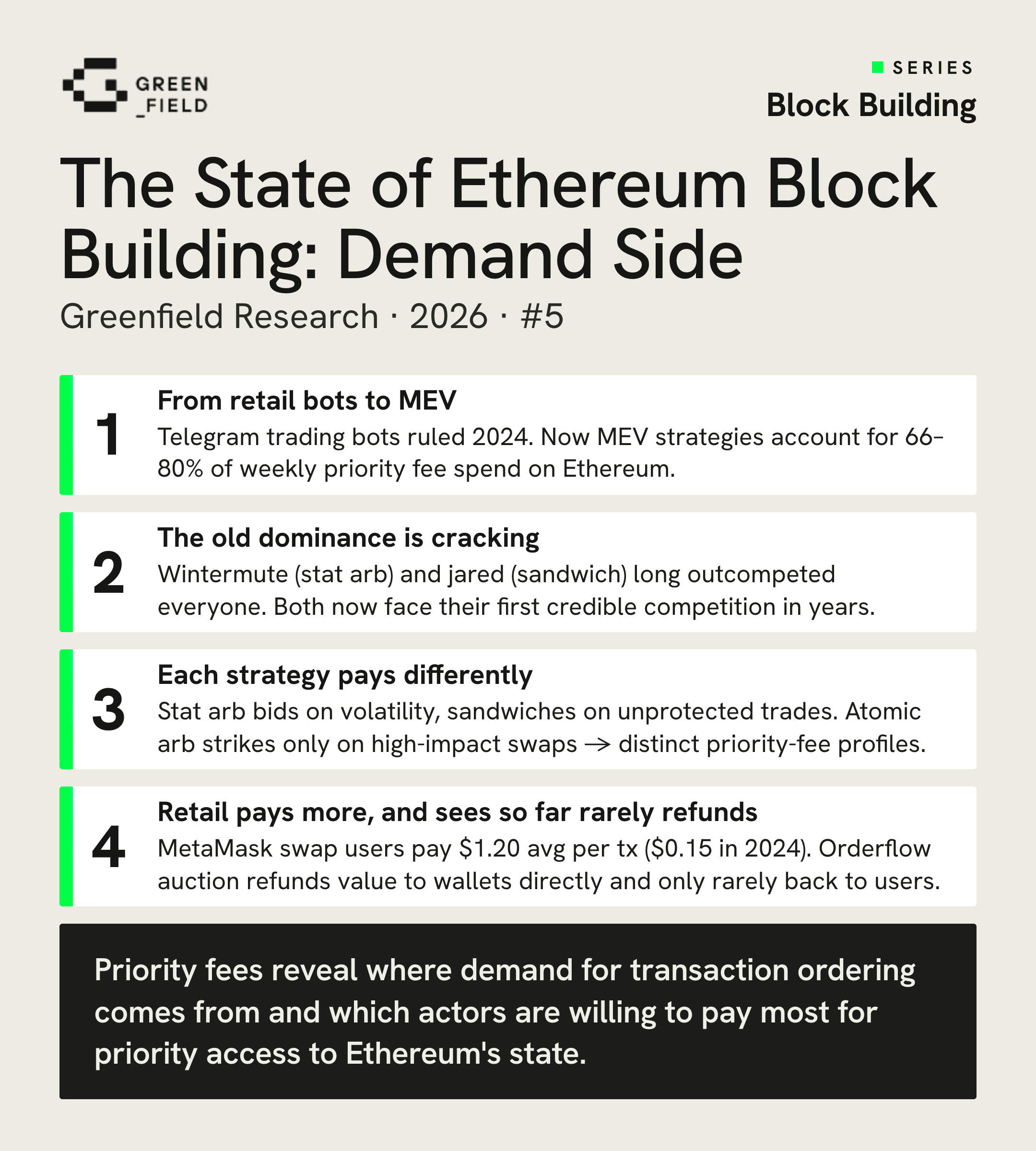
Key takeaways: Part 1
- Priority fees drive block values. We aim to understand the priority fee orderflow landscape on Ethereum to understand which categories (MEV, Telegram bots, Smart contracts, DEX Frontends, Wallet Swaps or Solvers) and players within these categories are driving priority fee spending.
- We find a move away from retail-facing Telegram bots which dominated 2024 towards MEV-related flow, accounting for roughly 66-80% of weekly priority fee spend now.
- We break down each of the 3 MEV markets by priority fees spent to see the stat arb and sandwich market being dominated by a single party (Wintermute and jaredfromsubway respectively) for a long time, who however are both now seeing fierce competition from new entrants into their markets at the same time. The atomic MEV market is seeing a very distributed competition.
- We aim to understand how opportunities for these different MEV strategies arise differently and how priority fee and DEX volume intensity differs per strategy.
- Besides MEV, within the retail-facing offerings we see a general move towards Wallet swaps (mainly MetaMask swaps) away from DEX frontends as well as a recent resurgence of Telegram bots with GMGN being a standout winner in recent weeks. And consider how priority fee refunds might be misaligning incentives between users and wallets encouraging increased priority fee spend.
- All data can be found in this Dune dashboard and will be maintained going forward to provide ongoing insights into the Ethereum Orderflow landscape.
Introduction & Motivation
Ethereum’s block building market has undergone significant changes since 2024. Shifts in orderflow distribution, increasing wallet-level monetization, the rise of private transaction routing, and evolving competitive dynamics among builders have materially altered how value is created and captured throughout the block production stack.
This piece is part of our broader research on Ethereum’s block-building ecosystem. Readers looking for an introduction to the market structure, key participants, and value chain may want to first read our recent primer on the block building market.
Building on that foundation, the core of our analysis is presented in a two-part deep dive into the economics of block building. We aim to understand the landscape of valuable and monetizable orderflow on Ethereum and how it shapes the block construction competition via builder-level outcomes. We also aim to understand how trends in orderflow and their relationships have reshaped the competition between block builders over the last years.
This first installment examines the state of Ethereum block building since 2024 through the lens of the demand side of the market, analyzing priority fee orderflow sources, user behavior, wallet monetization, and transaction priority fee payments. The second installment shifts focus to the supply side, exploring how builders compete, generate builder surplus, and capture value across the block production stack.
Together, these two articles provide a comprehensive view of how value enters, moves through, and is ultimately captured within today’s Ethereum block building ecosystem.
Our analysis is based solely on fully observable on-chain data, all of which can be found in this Dune dashboard and can be used to generate additional insights beyond what will be highlighted in this article. We aim to make the data forward-maintainable to provide insights into future changes in market structure.
Other important factors impacting the competitiveness of block builders, like latency differences or relay policies, are out of scope here.
Since the Merge in September 2022, MEV-Boost (the out-of-protocol implementation of PBS) has become the dominant mechanism by which Ethereum validators monetize the execution layer by allowing validators to sell ordering rights in their blocks in an auction to specialized entities known as block builders. This created a competitive marketplace for transaction ordering.
Because consensus layer rewards are funded by newly issued ETH, while the base fee for compute is burned via EIP-1559, execution layer rewards generated through block-building auctions are the only non-dilutive validator revenue stream directly tied to demand for blockspace.
That means the structure of the builder market influences not just who builds blocks, but how economically sustainable validator revenue is over time.
Furthermore, it impacts how efficiently blockspace is allocated among users and, depending on additional services block builders are able to offer, how good the user experience for interacting with that blockspace is (e.g., execution quality). This layer is where the market-driven value of transaction inclusion and ordering is priced, routed, and distributed, shaping all important downstream outcomes that users and validators care about.
Orderflow and priority fees definition
Orderflow refers to all transactions submitted for inclusion on-chain. Not all orderflow is equally valuable. Many transactions consume gas and pay ordinary fees, but do not create much incremental value beyond that.
Priority fees are payments made by orderflow originators to block builders for specific state access, ordering, and inclusion. These payments are separate from the base fee for compute (burned via EIP-1559) and are made to obtain inclusion of a specific transaction in a block in a certain order relative to other transactions. Priority fees are paid because many profitable opportunities on Ethereum are competitive, time-sensitive, and highly sensitive to exact ordering. This could, for example, be competing for a CEX-DEX arbitrage opportunity where only the first transaction to touch (trade against) the AMM pool captures the profit and the arbitrage opportunity disappears for everyone else, or a retail user trying to guarantee inclusion before others when buying an anticipated memecoin launch.
These fees are paid in the form of native priority fees or direct builder payments via coinbase.transfer, which for the purpose of this research fulfill the same goal. We sum these two components per transaction and refer to them collectively as priority fees throughout this research (also referred to as builder tips, or payments for state access). Associated priority fees are the main factor driving the value of orderflow.
Holistic view of Ethereum priority fee landscape
We start with a messy holistic view of Ethereum priority fee orderflow landscape by only grouping by orderflow originator address, to see which entities are most willing to pay for priority state access in blocks.
Demand for priority is highly variable, with significant spikes depending on market conditions like volatility (e.g., 10/10 crash) or extraordinary events such as the week of March 9, the highest total priority fee week and individual priority fee during the last years, being a result of a user on AAVE’s frontend suffering a $50M loss accepting a high slippage swap, leading to a $34M priority fee for backrunning priority (purple). This individual incident will show up in multiple metrics throughout this research.
We can see that the composition of total priority fees changes materially over time, going from a market where 2 players accounted for the bulk of priority fee spend (jaredfromsubway and Banana Gun telegram bot) to now having become less concentrated. Total priority fee spend has also decreased significantly since early 2024 (both measured in USD and ETH denomination) as a result of slower market conditions (like reduced retail speculation on Ethereum mainnet), leading to fewer opportunities.
Priority fee breakdown by flow category label
We use labels provided by Flashbots on Dune to add MEV labels as well as classify priority fees spenders by orderflow labels. This doesn’t fully encompass all unsorted priority fees we showed above, given it’s hard to maintain up-to-date labeling, especially with the fast-moving nature of MEV like searcher teams changing strategy contracts. We expect this to even undercount the contribution of MEV strategies slightly.
However, the relative breakdown over time highlights a major structural shift from the dominance of retail-facing Telegram trading bots & Trading terminals (red) as the largest priority fee spenders in early 2024 to the current dominance of MEV-related priority fee spend (dark blue). As can be seen above, the change was driven by the decline of telegram bot priority fee spend as a result of fewer opportunities for token sniping on Ethereum, which were driving spending. However in the most recent few weeks we have seen a strong increase in priority fee spending coming from Telegram trading bots & Trading terminals.
For the current retail-driven flow, we also see a shift away from DEX frontends (yellow) towards Wallet swaps (green), becoming a larger share by growing steadily over the years.
Lastly, the “Smart contract” category refers to priority fees users are paying when interacting with mainly token smart contracts, like USDC or USDT, such as simple token transfers or approvals. We see the notional spend in this category stay relatively even throughout the years, with between $100-200k spend per week, and it recently gained share as other categories are notionally declining.
Interestingly, since none of these transactions are competing for priority state access or faster inclusion, there would be little reason to pay additional priority fees. However, since these are the most used smart contracts on-chain, these are a result of millions of transactions per week paying a little more than they would need to (-99% lower average priority fee than other categories), which results in 24% share of total priority fee spend for this category.
We will break down each of these categories further in the next sections.
Last 45 days top 100 priority fee spenders
When looking at the top 100 priority fee spenders over the last 45 days in May 2026, we see a strong power law distribution, with 2 MEV-related addresses (jaredfromsubway & 0xbdb3) driving most priority fee spending with above $2.4M priority fee spend in the last 45 days and a sharp reduction after the top 15. We see MEV strategies accounting for 69% of total priority fee spend (dark blue), down from roughly 80% at the start of the year (as can be seen in the weekly bar chart above).
The top non-MEV-related priority fee spenders are Telegram bots (GMGN Terminal, Maestro and Banana gun) with especially GMGN standing out in third place and spending similar notional priority fees to jaredfromsubway and Wintermute. They are followed by the top Token smart contracts (USDC & USDT), and Meta Mask wallet swaps.
Priority fee share breakdown by flow category
We further break down the priority fee share by their orderflow category to separate between: Frontends, Metaggregators, Routers, and MEV labels. These labels are overlapping, for example, Meta Masks swaps as a frontend using Meta Mask swaps router.
Within frontends, we can see the decline of both large telegram bots (Banana Gun & Maestro) and the recent rise of Meta Mask swaps as one of the largest priority fee spending front ends (orange). Recently, all Telegram bots saw a resurgence, however with the standout being the entry of GMGN Terminal which recently expanded their product offering to Ethereum mainnet and now topping both the Frontend label and Router label category by spending 41% and 37% of total priority fee per category.
When looking at notional priority fees paid by the frontend category label we see that GMGN gained market share by bringing new users from their existing products to Ethereum mainnet which increased total priority fee spent from the frontend category label, rather than taking share from others, exemplified by Meta Mask swap priority fee spent remaining constant but drastically losing “market share”.
Within the Metaaggregator label, we see the Solver model (1inch Fusion, Cowswap & Uniswap X) being efficient in keeping priority fee spend low with Solvers as sophisticated parties in charge of managing this on the user’s behalf, as well as batching transactions (on Cowswap). Within routers, MetaMask Swap router led since mid 2025 (orange), being recently surpassed by Maestro router, followed by Uniswap, 0x, Aave, 1inch and Banana Gun Routers with similar shares.
As mentioned, the MEV labels are not all-encompassing, but we can see Wintermute’s (dark blue) resurgence to dominate priority fee spending within MEV-labeled contracts. As well as an impressive comeback by jaredfromsubway (gray) in recent weeks, which we will see more clearly later.
While Meta Mask wallet swaps have not grown considerably since early 2024, we see their users being willing to spend a current average of $1.2 in priority fees per transaction (manually select Meta Mask) up from roughly $0.15 in early 2024. Even more striking is GMGN users spending an average of above $2.1 which is almost comparable to Wintermute with an average of $3 per transaction (who however are capturing a trading profit each transaction on average). What has led to this change in willingness to spend on priority fees since 2024 from Meta Mask wallet swaps users?
Orderflow Auctions (OFAs) and priority fee rebates
One thing that is difficult to capture from on-chain data which has the potential to skew priority fee analysis is the growing prevalence of OFA priority fee rebates via delayed and aggregated priority fee refunds.
In addition to offering backrun opportunities to the highest-bidding searcher and refunding that bid to orderflow providers, OFAs have also moved toward providing a fixed percentage rebate on all priority fees. In this model, transactions flowing through an OFA’s RPC are shared with all qualifying builders and included by the builder that rebates a fixed percentage of priority fees (usually 90%).
There are differences in refund logic and monetization models, which are described in depth in this research. Refunded priority fees are usually not returned to originators in the same block, but rather paid out periodically. This makes it impossible to attribute refunds to specific transactions purely from on-chain data. See here for more information.
This can distort conclusions about who is actually paying for priority state access and how much they are truly willing to spend, as a significant portion of priority fees paid is ultimately rebated upstream to the orderflow source. However, we do not expect this to materially affect the overall conclusions. MEV-related priority fees, which account for by far the largest share of priority fee spend, are calibrated bids with priority fees set very precisely to win the bundle auction at the builder level over others competing for the same opportunity. Receiving a 90% priority fee refund would be economically similar to bidding 90% less for a specific opportunity from the builder’s perspective.
We expect consumer applications, which are in charge of their users’ RPC selection and facilitate uninformed orderflow where priority fees are often set loosely and imprecisely (resulting in frequent overpayment), to be the best fit for utilizing priority-fee refunds from OFAs. This has the potential to explain the elevated priority fee spend observed from wallet-originated flow, such as MetaMask averaging $1.20 in priority fees per transaction.
As these priority fee refunds are generally not passed through to MetaMask users, this has the potential to create a conflict of interest between minimizing user fees and maximizing wallet revenue. As the wallet has an incentive to encourage users while also often being in charge of suggesting default priority fees to guarantee inclusion, which most users blindly accept.
We have also recently seen significant consolidation in the OFA layer, such as Blink acquiring Merkle and Consensys / SMG (operating SERVO MEV protection) acquiring MEV-Blocker from CoW DAO. These relationships increasingly influence where flow is routed and who wins blocks, yet a large portion of their economics is difficult to observe directly from on-chain data.
Given the attribution challenges created by off-chain priority fee refunds, priority fee measurements for consumer applications should generally be treated as upper bounds on their users’ true willingness to pay for priority state access and inclusion.
We will cover this in more depth in an upcoming consumer orderflow research piece, on how retail-facing transaction flow is evolving, and what this means for consumer applications, business models, and monetization across the Ethereum transaction supply chain.
MEV-related priority fees
As we have seen, upwards of 66-80% of priority fees per week and therefore, block values are driven by different MEV strategies. To understand the MEV priority fee landscape better, we split MEV into the 3 most common forms on Ethereum: Statistical arbitrage (stat arb, CEX-DEX), Sandwich MEV, and Atomic arbitrage.
For stat arb, we re-use this classification from previous Greenfield research and rely on existing classifications for Sandwich and Atomic arb by Dune user @hildobby.
Given the competitive nature of MEV, searchers often have to pay a large fraction of their extractable profits to guarantee winning a certain opportunity over their competition via priority fees. Calculating their profits (what’s left after paying for priority fees) exactly is hard and error-prone. In previous Greenfield research, we used Binance markouts to estimate profit margins to assume roughly 10% profit margins (where 90% is spent on priority fees) for the average and up to 30% profit margins for the largest stat arb opportunities.
While different MEV strategies (and individual searchers within them) will have different average profit margins, depending on competitive dynamics such as economies of scale, we see priority fees as a very useful and reliable proxy for understanding the landscape, but we have to keep in mind that they don’t exactly correspond to MEV profits.
We start by comparing these 3 MEV strategies across their associated priority fees paid (right) and DEX volume (left). Stat arb is the largest category of the three leading for both metrics with 70-85% of MEV related DEX volume and often 50% of MEV priority fees coming from stat arb.
Atomic arb priority fees show significant spikes while being on a consistent uptrend since the start of 2025, and in recent weeks have often contributed upwards of 25% of total MEV priority fees. We speculate gas limit increases on Ethereum throughout the year to have made atomic arb (always involving multi-hop transactions) more competitive, as the November 2025 gas limit increase lines up with a higher share of DEX volume coming from atomic arb.
The share of priority fees coming from sandwiches has been in a consistent downtrend since leading the metric in early 2024 when it used to dominate MEV related priority fee spend with above 60%. This can be explained by a larger share of retail trades bypassing the public mempool, as MEV protection infrastructure has matured over the years, such as private RPC or dApp-level solutions, such as batching via Cowswap. This can be seen by an increasing amount of transactions bypassing the public mempool with 92% of DEX volume being routed through private mempools in recent months.
However, in the recent weeks, there seems to be a considerable uptick in sandwich MEV-related priority fee spending, with 35-51% coming from this strategy again. We consider potential reasons in the next chapters.
As you can infer from the above differences between DEX volume and priority fees, these three strategies have different priority fee intensities per opportunity. We show the average priority fee per transaction and per dollar of DEX volume (percentage) per MEV category.
Stat arb has the lowest priority fee intensity per transaction and percentage of DEX volume, as a result of more frequent but lower total extractable value opportunities. Atomic arb is especially priority fee intensive, with x10 more DEX volume per $1 of priority fee spend, with an average of 0.4% of DEX volume related to atomic arb being spent as priority fees.
Currently, roughly 38% of Uniswap volume is coming from stat arb-related transactions, having reached as low as 5% around the start of 2026 and a high of above 45% at the start of 2025. We can see a strong correlation between stat arb as a percentage of Uniswap volume and Deribits BTC DVOL index (the correlation would be even stronger, looking at ETH 12s realized volatility between blocks), as the scope of stat arb opportunities depends on the volatility of asset trades on both CEXs and AMMs.
In total, roughly 49% of all Uniswap volume is currently coming from these 3 identified MEV strategies, having reached as high as 56% in early 2024.
By separating different MEV strategies we are able to differentiate between ordinary market behavior such as arbitrage which aligns prices and more extractive activity harming unsuspecting users like sandwiching, which are often combined under the same loaded term. While improvements to pre-trade privacy can massively decrease sandwich MEV, we see priority fees paid for priority access to shared state e.g. winning an arbitrage as a structural property of blockchains. Since when multiple parties contend for the same state, and that state is only updated in sequential intervals, priority access to that state always has economic value. In order books like on NYSE or NASDAQ priority access also has the same economic value but as matching is first-come-first-serve, it is priced via investments in latency (co-location, faster hardware) rather than transparent, on-chain priority fees.
Stat arb (CEX-DEX) market breakdown
We now look at which players are dominating the stat arb market by DEX volume (left), priority fees paid (right) and relative share of priority fees (bottom).
The relative breakdown is particularly interesting as the priority fee market used to be dominated by Wintermute (blue) & SCP/beaverbuild (pink) together controlling roughly 50% share from early 2024 until Sep 2024, with the rest being won by a fairly distributed longer tail. After Sep 2024, a stat arb searcher labeled “Kayle” in previous research quickly gained market share, however both Wintermute & SCP managed to regain and even increase their market share by April 2025, pushing other stat arb searchers out and controlling upwards of 75% of the market.
After the gradual transition from beaverbuild to BuilderNet (this will be covered again below), SCPs searcher loses market share starting in December 2025, leaving Wintermute to dominate 70% followed by SCP with roughly 5%, 0x7cDa58 (which seems to be a new contract of the team previously operating the labeled “Kayle” contract) for the first 3 months of 2026 when market share within stat arb was the most concentrated it has been.
In recent months 0xbdb3ba (peach) has emerged as challenger to Wintermute with roughly similar market share by priority fees spend and together being responsible for 83% of total priority fee spend within the stat arb category. This contract has a unique strategy of bundling all their stat arb swaps into a single transaction which can have 50+ single leg swaps, as can be seen in this example.
Which team is behind this contract currently challenging and inching ahead of Wintermute for stat arb opportunities is not clear. By checking manually it seems 0xbdb3ba similarly to Wintermute has a routing preferences to Titan, which only indicates that they are not being affiliated or vertically integrated with any other existing builder.
Sandwich market breakdown
We look at the same metrics for the sandwich market, where we see the larger decline in priority fees associated with sandwich MEV described above. Furthermore, to no surprise to anyone who has ever gotten sandwiched on Ethereum mainnet, we see how impressively jaredfromsubway (dark blue) has managed to hold the dominant position over the last few years with little changes to market share and relative priority fees paid hovering between 70-85%.
Note: This data shown here was collected before jaredfromsubway main contract got drained for over $15M. How this incident will shape Sandwich competition in the coming months remains to be seen.
By manually deselecting jaredfromsubway, on the other hand, we see a quite rapidly changing market with different players rising and declining quickly and much quicker compared to longer tail stat arb when deselecting Wintermute & SCP. Compared with stat arb, the sandwich market is more stable at the very top but much less stable below it.
We see 0x01FD (dark green) recently managing to claim the number 2 spot behind jared spending roughly 20% of total sandwich MEV priority fees and managing to hold this place for multiple weeks already, and seeming like jaredfromsubway most credible competition in a long time.
While the reasons for the above observed sudden increase in priority fees related to sandwich (45-60% of MEV priority fee spend in the last 3 weeks) are hard to know, we can speculate that this increased competition could have lead to a priority fee war (leading to lower profit margins) between jaredfromsuway and 0x01FD as they are the only real drivers behind the increased priority fee spend.
This is reflected in the increased priority fee spend intensity per dollar of DEX volume (manually select), with jaredfromsubway (dark blue) spending roughly x3 more in priority fee per $1 in DEX sandwich volume compared to 4 weeks prior, potentially as a reaction to 0x01FD competition (orange).
As we will describe in Part II, the 0x01FD seems to likely be operated by the same team behind BobTheBuilder.
Atomic arb market breakdown
When looking at the atomic arb market, we see quite a different picture. As shown before, the entire arb market is a bit smaller, but opportunities are also significantly more variable, leading to higher spikes.
This is logical as large atomic arb opportunities often arise from individual users swapping with high price impact on AMM liquidity pools (on accident or purpose) which enables atomic arbitrage to again align prices between all AMM pools (as somewhere moved out of line by the high impact swap), without the CEX price having diverged.
An example of this is the AAVE frontend swapper incident (swapping $50M into $35k) mentioned above, which led to the highest atomic arb priority fee we observe since the start of 2024.
These outlier events, which often happen from user input errors, happen less frequently. This is different from stat arb, which always arises when the CEX price diverges from the DEX price between 12-second block intervals, occurring at a regular frequency depending on volatility. Or a certain number of users always choose to trade without sandwich protection by sending their transaction into the public mempool. This explains the more variable nature of atomic arb priority fees.
Furthermore, we see this is the only of the different 3 MEV markets with a very distributed competition without a single party regularly dominating the market.
This can likely be explained by a smaller overall pie to capture, as well as fewer natural economies of scale for purely atomic arb (e.g., flashloans reducing capital barriers). These are very different market conditions compared to stat arb (dictated by latency, inventory, CEX fee tiers in which Wintermute has an edge over the competition) or even sandwich, as jaredfromsubways’ strategy of holding a lot of inventory gives similar economies of scale, which has allowed for long periods of dominating their respective categories.
Part 1: Conclusion
Part I shows that Ethereum priority fee demand is not a single uniform market, but a collection of distinct orderflow segments with very different economic drivers. Since 2024, the composition of valuable orderflow has changed materially across both categories and individual actors, with each segment evolving under its own competitive dynamics. This is especially visible within MEV, where stat arb, sandwiching, and atomic arbitrage differ significantly in concentration, opportunity frequency, and priority fee intensity.
This first part focused on the demand side: who generates valuable orderflow and why they pay for priority. Part II turns to the supply side, examining how builders compete to access this flow, how it translates into builder surplus, and how Ethereum’s increasingly specialized orderflow providers and their unique demands for services shape the block production market.
If you have feedback or are interested in these topics, feel free to reach out on Telegram (https://telegram.me/@thirdeye33) or email (christoph@greenfieldcapital.com).
All charts and underlying queries can be found in this Dune dashboard and will be maintained going forward to provide ongoing insights into market structure changes.
Greenfield has investments in Titan’s parent company Gattaca, CoW Protocol and NuConstruct. This analysis is based exclusively on publicly available on-chain data via Dune Analytics. The findings reflect on-chain observations and independent research views, not portfolio advocacy or investment advice.
The analysis may reference projects, protocols, builders, searchers, and market participants in which Greenfield may have a direct or indirect interest. Any such references are for research and informational purposes only and should not be interpreted as endorsements, recommendations, or representations of future performance.