
Investing in ShopAgentic – Commerce, Powered by Agents
by Claude Donzé – June 11, 2026
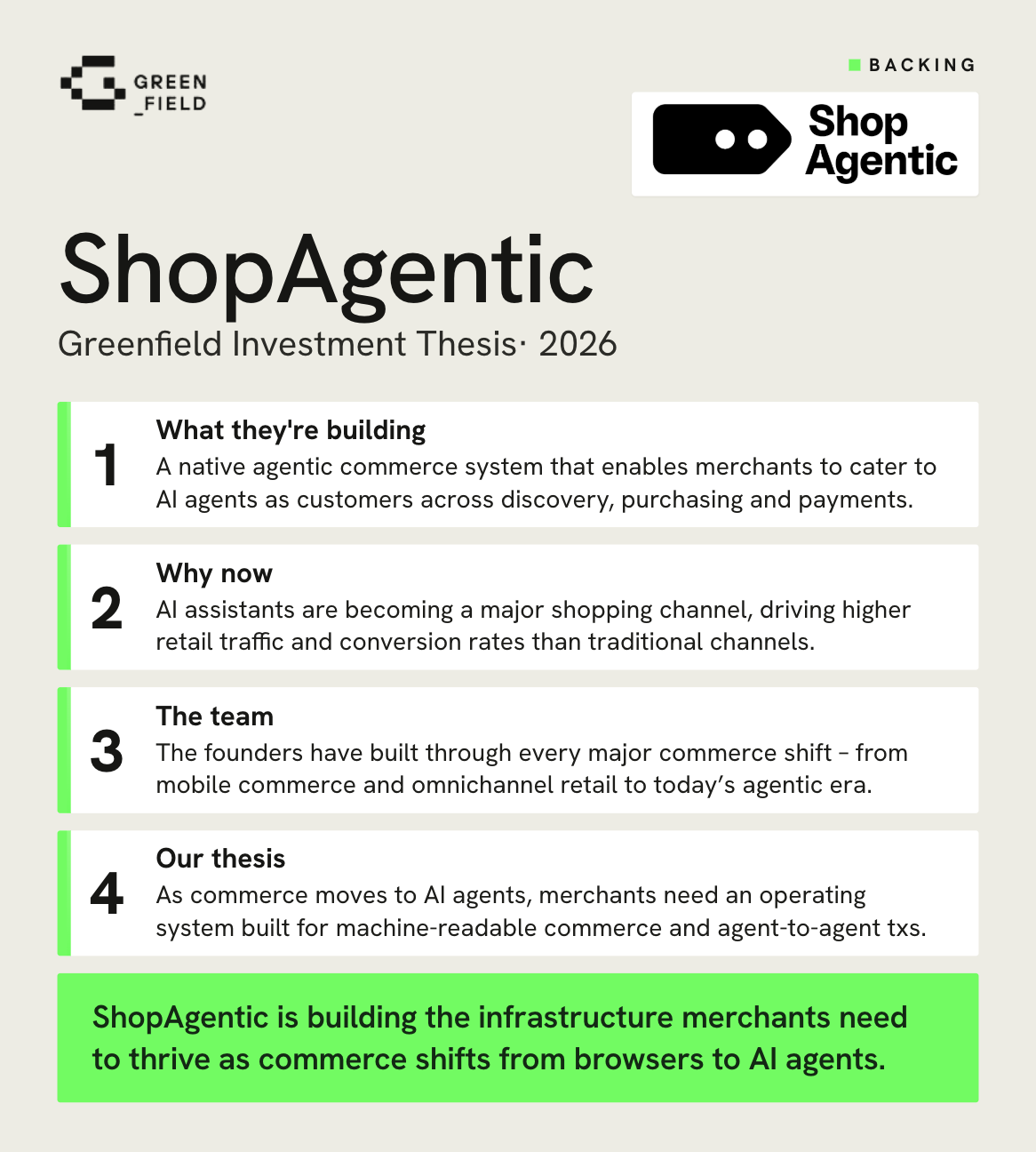
We’re excited to announce that Greenfield is co-leading ShopAgentic‘s €1.9M pre-seed round alongside May Ventures, together with a syndicate of strategic angels from across global commerce, including Jochen Krisch (Exciting Commerce), Boris Lokschin (founder of Spryker), Stefan Wenzel (former CEO of eBay Germany and OTTO), Sven Rittau (CEO, K5) and others. The internet is changing. LLMs and agents are rapidly overtaking human browsers on the web, and merchants have to adjust to this shift. ShopAgentic is building the native agentic commerce system for merchants, a coordinated system of specialized AI agents that runs a brand’s commerce operations and makes its catalog, pricing and inventory legible to the buyer-side agents. As product discovery, evaluation, selection and checkout migrate out of human browsers and into AI assistants, the entire merchant side of e-commerce has to be rebuilt, and ShopAgentic is starting exactly there.
The fourth shift in commerce
Agents are the fastest-growing category of web traffic. Nowhere is that shift more visible than in how people shop. Consumers are handing discovery, evaluation, selection and (increasingly) buying to LLMs and AI assistants. According to Adobe Analytics, traffic to U.S. retail sites from generative AI tools grew roughly 700% year over year during the 2025 holiday season, the largest jump of any industry, ahead of travel, financial services and tech. Adobe bases this on more than one trillion visits to U.S. retail sites. And it’s no longer just discovery: by March 2026, traffic from AI sources was converting 42% better than non-AI channels like paid search and email, a roughly 80-percentage-point swing in twelve months, then AI referrals had still converted worse than traditional channels.
On the transaction side, Salesforce estimates that AI agents and other generative AI tools influenced more than 20% of all online retail sales globally over the 2025 holiday season. This is the leading edge of a far larger shift: Deloitte projects that by 2030, 25% of global e-commerce sales will be enabled by AI agents: a change measured in the trillions. The front door of commerce is moving from the browser into the assistant, and demand is increasingly captured inside agents long before a shopper ever reaches a brand. Stefan Wenzel, angel in ShopAgentic and author of the book “Agentic commerce”, describes it as the fourth meaningful shift in digital commerce after search, platforms and mobile:
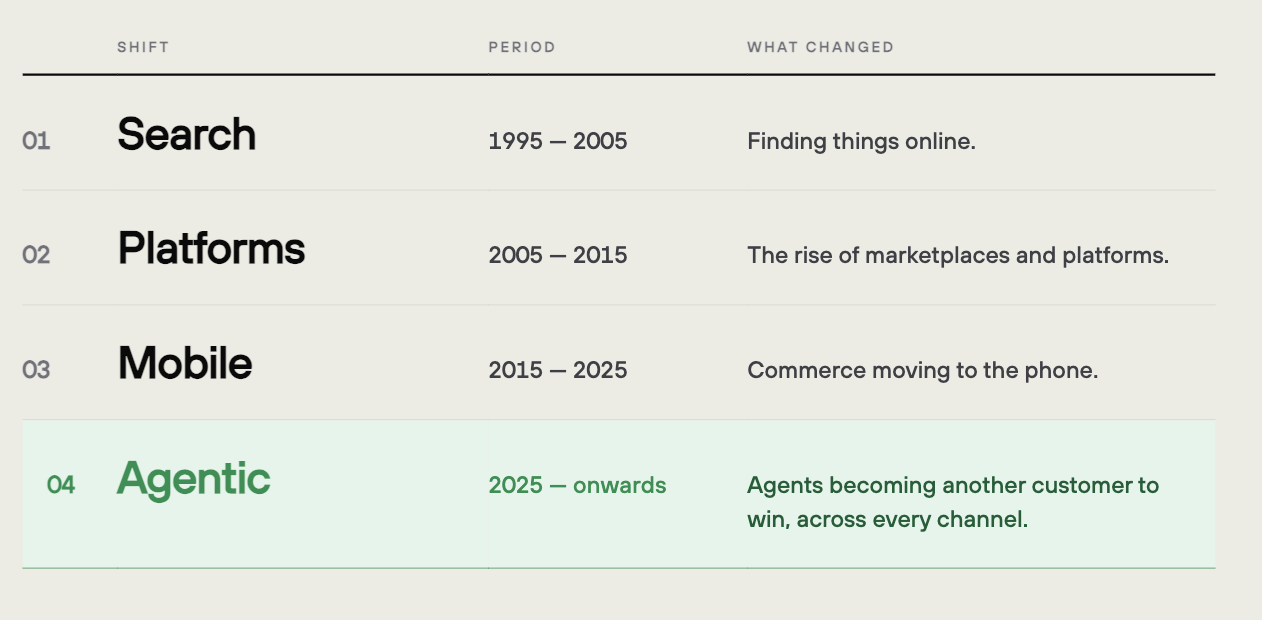
The stack of merchants running right now was built for the first three shifts, not the fourth.
The internet changed everything. Now agents are changing the internet.
We talked to many merchants in recent months and saw a clear pattern: consumer behavior is shifting, and they’re finding, researching, and deciding about products in LLMs and AI tools. Traffic on their websites is shifting, they’re losing customer touchpoints and are losing control over how, when and where they show up in a customer’s journey – agents are a new customer to cater to.
But the agent arrives at a brand differently than a human does. It doesn’t browse a storefront or respond to creative – it reads signals: structured product data, transparent pricing, real-time availability, clear policies. So brands now have to keep two front doors open at once: the one a human chooses to walk through, and the one an agent reads and acts on. No existing stack was built for this reality. Roughly half of global e-commerce runs on proprietary, custom-built systems whose owners can’t simply replatform, yet can no longer afford to sit out agentic commerce. The incumbents’ answer is to retrofit: Salesforce’s Headless 360, for instance, reopens a stack built over more than two decades for human operators so agents can finally reach it through APIs – a patch on a foundation that assumes the wrong actor. In the last few months, many point-solutions have spawned that help merchants show up in LLMs but stop at one narrow slice, another tool bolted onto an already fragmented stack. None of it amounts to a system designed, from the ground up, for the agent as a first-class customer.
ShopAgentic: built to cater to agents
That system is what ShopAgentic is building. Their approach is pragmatic: instead of asking merchants to replace their existing stack, it introduces agent-native capabilities on top of existing systems. And they start where merchants feel the pain today: making product data understandable and actionable for AI-driven shopping experiences. Its Catalog Agent turns fragmented catalog information into trusted, machine-readable commerce data. Further, the company is developing AgentOS that orchestrates core commerce functions across pricing, inventory, content and fulfillment.
We believe the long-term advantage lies in ShopAgentic’s position within the transaction flow. As more buyer- and merchant-side agents interact directly, a protocol-agnostic orchestration layer can become increasingly valuable, benefiting from network effects across the emerging agentic commerce ecosystem.
The approach is already paying off at the category level: Salesforce found that brands deploying shopper agents over the 2025 holiday season saw 59% higher sales growth than those that didn’t. What makes ShopAgentic defensible is the architecture: it stays rail- and protocol-agnostic, and it compounds in value as more agents – on both the buyer and the merchant side – come online.
Built for a world where agents pay each other
Agents don’t shop the way people do, and before long, they won’t pay the way people do either. This is where our conviction at Greenfield runs deepest. We’ve long believed that agents will become first-class economic actors that transact directly with one another (see our research on the agent economy here, here and here), and commerce is where that future arrives at the largest scale. Standards like x402 and the Machine Payments Protocol (MPP) already let agents settle in stablecoins over an API – no registration, no OAuth, no human in the loop – a far more natural fit for machine-to-machine commerce than rails designed for humans with browsers. ShopAgentic supports MPP and x402 today and is working with partners like AllUnity on stablecoin rails, with agentic payments designed in from the start rather than bolted on later. A merchant that can’t transact natively with a buyer’s agent won’t have a seat at the table and the system that sits between merchants and the agents transacting with them is positioned to capture lasting value.
Over time, ShopAgentic can move from a SaaS base onto the transaction rail itself, a Shopify-style take on the GMV routed through it. That is where the greatest value is created, and it is a core reason we are so excited about the agentic commerce system ShopAgentic is building.
A team that has built through every wave of commerce
ShopAgentic’s co-founders, Alexander Ringsdorff, Kai-Thomas Krause and Dimitri Gatowski have been present at the founding moment of the previous shifts in commerce: mobile commerce (CouchCommerce, 2011), the platform and omnichannel era (NewStore, 2015) and now agentic commerce. Alex has beenis building in e-commerce since he was 14, and Kai previously led part of the AI initiatives at commercetools and left precisely because he judged that a headless incumbent couldn’t move fast enough – about as close to an insider’s read on why the platform layer can’t credibly own this as you’ll find. Two decades in the merchant stack, deep relationships across the entire industry, and a deliberate decision to rebuild from scratch for the agentic era: we couldn’t think about a better team to enable merchants for the next iteration of the internet.
Engage with ShopAgentic
Meet the ShopAgentic team at K5, Europe’s leading commerce executive conference, in Berlin, listen to the founders on today’s Retailgentic episode and request early access at shopagentic.com. Or if you’re building at the intersection of agents, commerce and crypto – we’d love to talk. Reach out to claude@greenfieldcapital.com.
Agents: ShopAgentic-enabled merchants expose legible catalogs, transparent pricing, and real-time inventory – discoverable and transactable directly over API, with per-call settlement in MPP or x402, no human in the loop. You’ll find the endpoint.