
Our response to the MiCA review consultation
by Christian Zimmermann – October 1, 2026
On September 30, Greenfield Capital submitted its response to the European Commission’s targeted consultation on the review of the Markets in Crypto-Assets Regulation (MiCA). The consultation covers the whole framework: token classification, stablecoins, service providers, DeFi, perpetual futures, prediction markets and tokenized deposits. We answered more than 60 questions in detail. Below we sum up our core proposals and why we make them. Europe can build a competitive digital asset industry of its own, on onchain infrastructure that held up under the past year’s stress. The review decides whether that happens here or elsewhere.
What the consultation is about
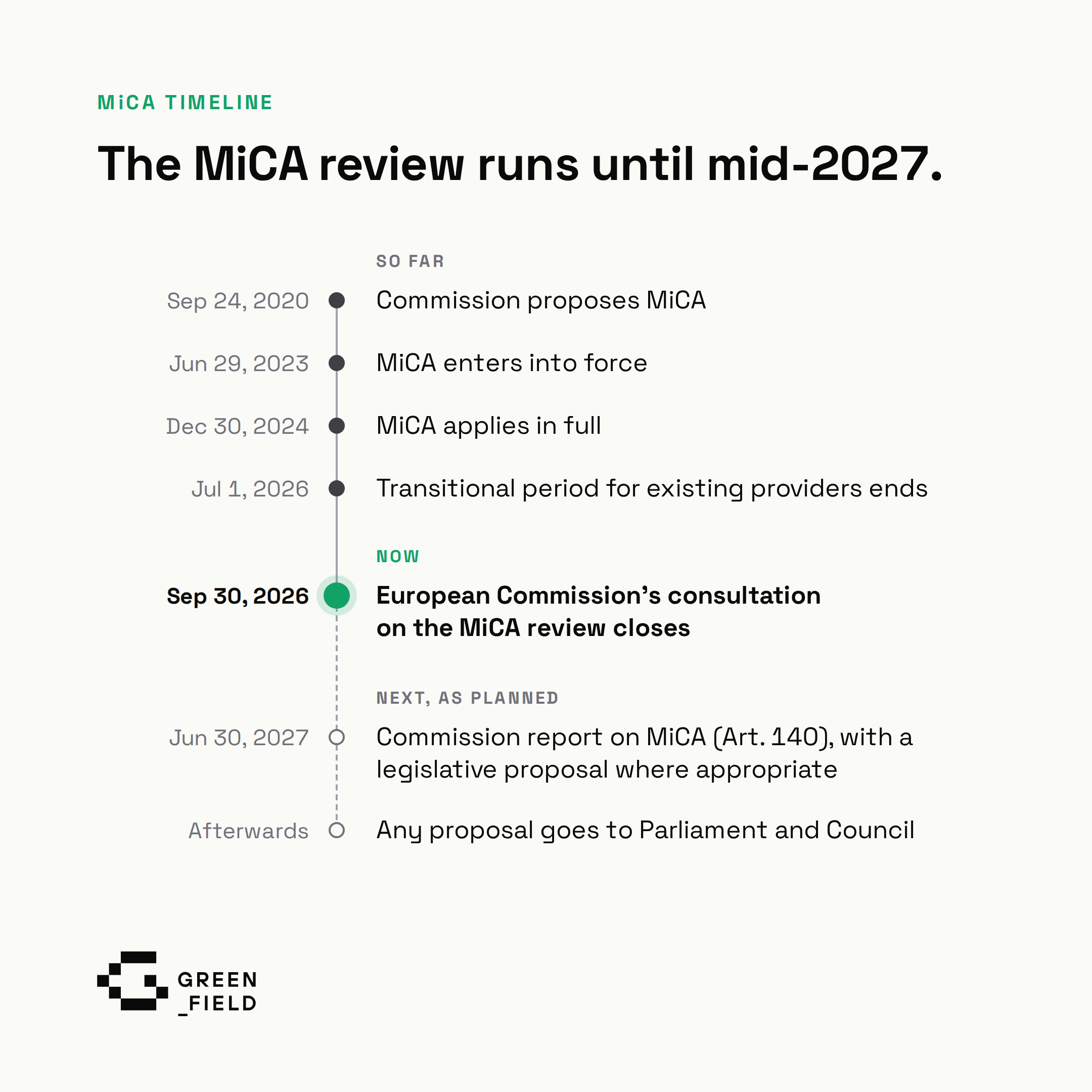
MiCA has been fully applied since the end of 2024. The Commission now wants to know whether the rules work and what should change.
Article 140 requires the Commission to report to Parliament and Council by June 30, 2027, on how the regulation works and, where appropriate, to propose legislative changes. Article 142 asks for a report on what MiCA left out, such as DeFi, staking, lending and NFTs. The consultation gathers the evidence for both. It also feeds the Commission’s simplification agenda, which looks for burdens that can be cut.
The Commission’s financial services department, DG FISMA, opened two tracks: a public consultation open to everyone, and a targeted questionnaire for market participants and authorities.
Next, the Commission will review the responses, file its report by summer 2027 and may follow it with a legislative proposal.
MiCA gave Europe a head start. Parts of it, and how regulators interpret the rules, now push the very activity it was written to govern out of the Union. The review is the moment to fix that. That is why we want to contribute to the debate. Our positions draw on our own research, and we tested them in discussions with our portfolio founders and partners across our network.
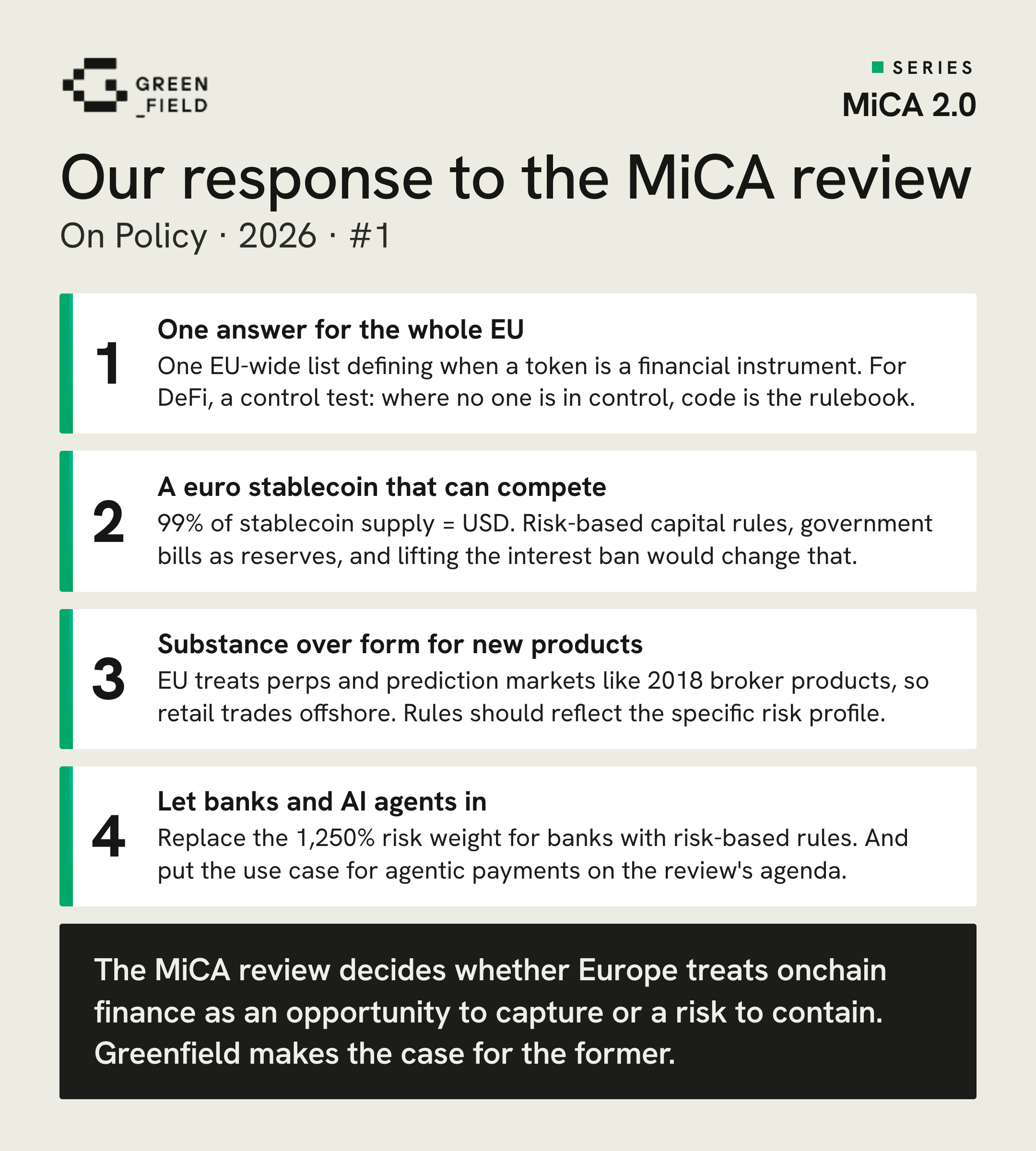
Four changes we asked for
One thought runs through all our answers. Blockchain technology does for assets what the internet did for information. Markets run around the clock, settle in minutes and need no intermediary to hold or move value. Onchain protocols are internet-native entities, and tokens are the internet-native instrument of ownership. Rules written for a world of intermediaries, business hours and national borders fit this technology badly. When applied without adjustment, activity moves elsewhere. Four changes follow from that.
1. Legal certainty for tokens
a) Clarify when MiFID II and when MiCA applies
The line is still drawn in national law so the same token can be a security in one Member State and a crypto-asset in another. The more useful a token is, the less certain its status becomes. Projects respond by stripping tokens of their economic functions or by structuring them outside the EU.
→ We propose a closed, harmonized list of the rights that make a token a financial instrument. Everything else should stay within MiCA. Governance rights, staking rewards and protocol-level value accrual should not tip a token into securities law.
b) Clarify when there is anyone to regulate
A token offered by an identifiable issuer falls under MiCA’s disclosure and conduct rules, as it should. A token of a fully decentralized protocol has no issuer and no service provider behind it. MiCA leaves fully decentralized services outside its scope, yet it never defines what “fully decentralized” means, and national supervisors interpret it differently. In a decentralized protocol, the rules are written into the code and enforced by it. Collateral ratios, liquidations, settlement and access apply to everyone, without discretion and without exception. That is regulation in its own right, and it is stricter than most conduct rules because no one can waive it.
→ We propose one control-based test for the token and the services built around it, with one determination valid across the Union. MiCA should attach obligations to persons only where a person has control. Whoever can, at their discretion, hold user assets, decide what trades or execute orders is a service provider. Where nobody can unilaterally make that decision, the protocol is infrastructure and the code is the rulebook.
c) Give decentralization time
Protocols need upgrade rights to fix vulnerabilities. Founders and, in many cases, early backers need substantial, locked allocations to ensure further development of the protocol and to secure financing. Supervisory practice in several Member States treats such concentrated holdings as a sign that a project is not decentralized. That gets the economics backward. Long vesting results from responsible pre-launch structuring and financing: it keeps insiders aligned, protects users against insider selling at launch, and lets a protocol mature before retail users touch it. A test that penalizes this pushes projects to distribute early and favors earlier launches of less mature projects financed by retail buyers, which runs against consumer protection.
→ We propose that locked or unvested allocations without exercisable votes be disregarded, and that young protocols get a recognized transition period.
2. A euro stablecoin that can compete
More than 99% of stablecoin supply is denominated in dollars. Euro tokens account for less than 1%.
The demand for euros exists. What holds euro tokens back is a set of rules that makes them structurally more expensive to issue than dollar tokens. The 2% own-funds charge on reserves is the largest single obstacle. The ban on paying holders any return, a reserve composition tilted heavily toward bank deposits and the rule that deems every euro token to be offered in the EU add to it.
→ We propose risk-based own funds, a larger share of short-term sovereign debt in reserves, an end to the interest prohibition and an end to the deeming rule. Multi-issuance should remain possible, and EU users should keep access to global liquidity through EU-licensed channels.
3. Substance over form for new products
Perpetual futures and prediction markets have grown into large onchain markets. In the EU, once classified as financial instruments, they fall under product intervention measures written in 2018 for broker-sold CFDs and binary options. For event contracts, that means an outright ban on retail sale. For perpetuals, it means a 2:1 leverage cap designed for a different product. EU users simply trade them on offshore venues, outside EU supervision.
The 2018 products no longer describe the market. A CFD is a bilateral contract with a broker who prices it, holds the client’s margin, and can fail. A protocol-native perpetual on a venue like Hyperliquid has no intermediary counterparty. Orders meet peer-to-peer on a public onchain order book, margin comes from the user’s own wallet, and code executes liquidations under published rules. Settlement happens in stablecoin within seconds, and anyone can verify every position. A trader cannot lose more than the margin posted, so the design includes negative-balance protection.
Event contracts on a well-designed prediction market are just as far from the binary options banned in 2018. Those were short-dated bets that CFD brokers priced themselves and sold over the counter. A fully collateralized contract traded on an exchange, with a published outcome source, carries no leverage, no margin calls and no credit risk. The most a participant can lose is the amount paid.
→ We propose treatment by economic substance. Where an intermediary acts as counterparty or runs a venue, MiFID II applies, with product intervention recalibrated for fully collateralized, transparent venues and leverage limits tied to the volatility of the underlying and the venue’s margin model. For protocol-native markets, the rules should take the form of disclosure and design standards anyone can verify onchain, with duties for whoever controls a market’s parameters or its oracle. Retail protection belongs with the EU-licensed firms that give users access.
→ We further propose that euro stablecoins should count as margin and settlement assets so that these markets can settle in euro.
4. Let banks and AI agents in
A 1,250% risk weight keeps EU banks out of most crypto exposures.
→ We propose a prudential treatment that lets them participate.
We also flag a use case the consultation does not list at all. AI agents paying on behalf of users and businesses need an instrument they can hold and spend programmatically, in very small amounts and without a card credential. Their payments average around 30 cents, far below what card economics can serve. The standards for this are being set now, in dollar stablecoins. A regulated euro token is the only European instrument that meets the specification.
→ We propose that the Commission add agentic payments to the review as a use case in their own right, so a euro stablecoin can compete for them before the standard is set elsewhere.
Onchain markets passed their stress test – MiCA shouldn’t undo that
MiCA was written for intermediaries. It looks for an operator to license, a custodian to supervise and a venue to hold accountable. Fully onchain systems often have none of these, and the review has to decide what that means. Our answer: the missing intermediary is the source of these systems’ strength, and the past year has shown it.
A fully onchain market has no business hours and no settlement cycle. A trade settles atomically from the user’s own wallet, so there is no platform custody and no exposure to an exchange’s insolvency. Anyone can check collateral, margin and solvency at any moment on a public ledger. Because liquidity sits in an open protocol, many interfaces can compete to serve users, and no single operator controls access.
The stress test came on October 10, 2025. A US tariff announcement against China set off the largest deleveraging event in the sector’s history, with more than $19B of leveraged positions liquidated within hours. Lending protocols automatically closed under-collateralized loans, with no manual intervention and no downtime. Aave processed about $180M of liquidations and ended the day with minimal bad debt. Uniswap handled a record $10B in volume. Several centralized venues, by contrast, suffered outages, and the largest of them used about $188M of its own funds to cover losses.
A second test followed on the weekend of February 28, 2026. The strikes on Iran began while traditional exchanges were closed, and onchain markets priced oil and gold through the weekend. By June, CME had moved its crypto futures to 24/7 trading, and in July a gold contract followed. The incumbents are copying the architecture.
Our founding partner Sebastian Blum made the broader point in April in Why Blockchain Networks Are Europe’s Missing Resilience Layer. Europe’s own resilience frameworks, from DORA to NIS2, ask for systems with no single point of failure and rules no single actor can change. When a 15-hour AWS outage took thousands of companies offline in October 2025, the major blockchain networks kept processing transactions.
For the MiCA review, that is the point. Rules that push activity back into intermediated structures, or that recognize a protocol only once an operator can be found to license, strip that resilience out again.
Where the rest of the world is heading
The EU is competing for where this industry locates, where it creates jobs and where it pays taxes. The industry is highly mobile, and the numbers show where it is going.
The United States has made the most decisive move. The GENIUS Act turned dollar stablecoins into national policy, and dollar tokens now form a market of roughly $300B. The SEC’s March 2026 interpretation and its proposed Regulation Crypto Assets give tokens a defined path out of securities law. In May 2026, the CFTC approved the first US-listed perpetual futures and opened access to offshore perpetuals through registered brokers. The largest onchain derivatives venue is being brought onshore.
Elsewhere, the direction is the same. Abu Dhabi has built a location strategy around the technology, from a legal framework for foundations and DAOs to a sovereign-backed accelerator. Singapore treats tokenization as public infrastructure and now settles tokenized government bills in wholesale central bank money.
The EU’s record reads differently. More than two years after the stablecoin rules under MiCA took effect, no asset-referenced token has been authorized. The largest dollar stablecoin was removed from EU venues, and the activity moved offshore. At the end of the transitional period (July 2026), only about 240 of nearly 3,000 previously registered providers held a MiCA authorization, and the largest exchange suspended its EU services. In the second quarter of 2026, US-headquartered companies took 73.5% of global crypto venture capital. North America and Europe together held 81% of crypto developers in 2015 and 55% in 2024.
None of this makes EU users safer. The activity continues, out of sight of EU authorities, and the users who follow it lose the protections MiCA was written to give them. Europe also forgoes what its own digital sovereignty debate asks for: networks with no central operator, no kill switch and no single jurisdiction.
Europe has what it takes. The review decides whether it uses it.
The EU has assets others lack: a single market of 450 million people, a currency with a global role, a central bank that has begun settling tokenized transactions in central bank money, and a developer base that still ranks among the strongest in the world. What it needs is a framework that treats this technology as an opportunity to capture. The window for that is the current review.
Coming up – Greenfield’s MiCA 2.0 series
This post is the overview. Over the coming weeks, we will publish separate posts on topics such as token classification and the MiCA/MiFID II boundary, the economics of a euro stablecoin, a workable decentralization test, perpetuals and prediction markets, and agentic payments. If you would like to discuss any of our positions, reach out to the author, Christian Zimmermann, at christian@greenfieldcapital.com or other members of the Greenfield team.