
Why We Run Network Infrastructure
by Andrzej Dzius – October 13, 2026
This summer, Greenfield became one of the independent node operators in NEAR’s Chain Signatures network. Chain Signatures lets a single NEAR account sign transactions on other blockchains. It powers NEAR Intents, where users state the trade they want and solvers compete to execute it; this has settled more than $33B in volume to date. We run nodes on several networks. Time to explain why a firm that invests in decentralized networks also helps operate them.
NEAR’s Chain Signatures network makes a good case study, for two reasons: it addresses one of crypto’s most expensive problems, and operating it is demanding work.
Many cross-chain systems have relied on a small set of trusted keyholders to custody bridged assets. That trust model is behind some of the largest losses in crypto: at Ronin ($625M), Harmony’s Horizon bridge ($100M) and Multichain ($126M), attackers or insiders gained control of enough keys to drain funds.
Chain Signatures is decentralized. A single NEAR account can control addresses on Bitcoin, Ethereum, Solana, and more than 30 other chains, yet no machine ever assembles the private key behind those addresses. It exists only as fragments held by the network’s independent operators. A valid signature requires a threshold of them acting together. No operator can sign alone. If too many nodes go offline, signing pauses, but the key stays safe.
Running a node in this system takes more than running a standard validator. Our key share sits inside a hardware enclave (Intel TDX), and the node continuously proves to the network that it runs the correct software. That calls for specific hardware, working attestation and a disciplined operating routine.
Not a one-off
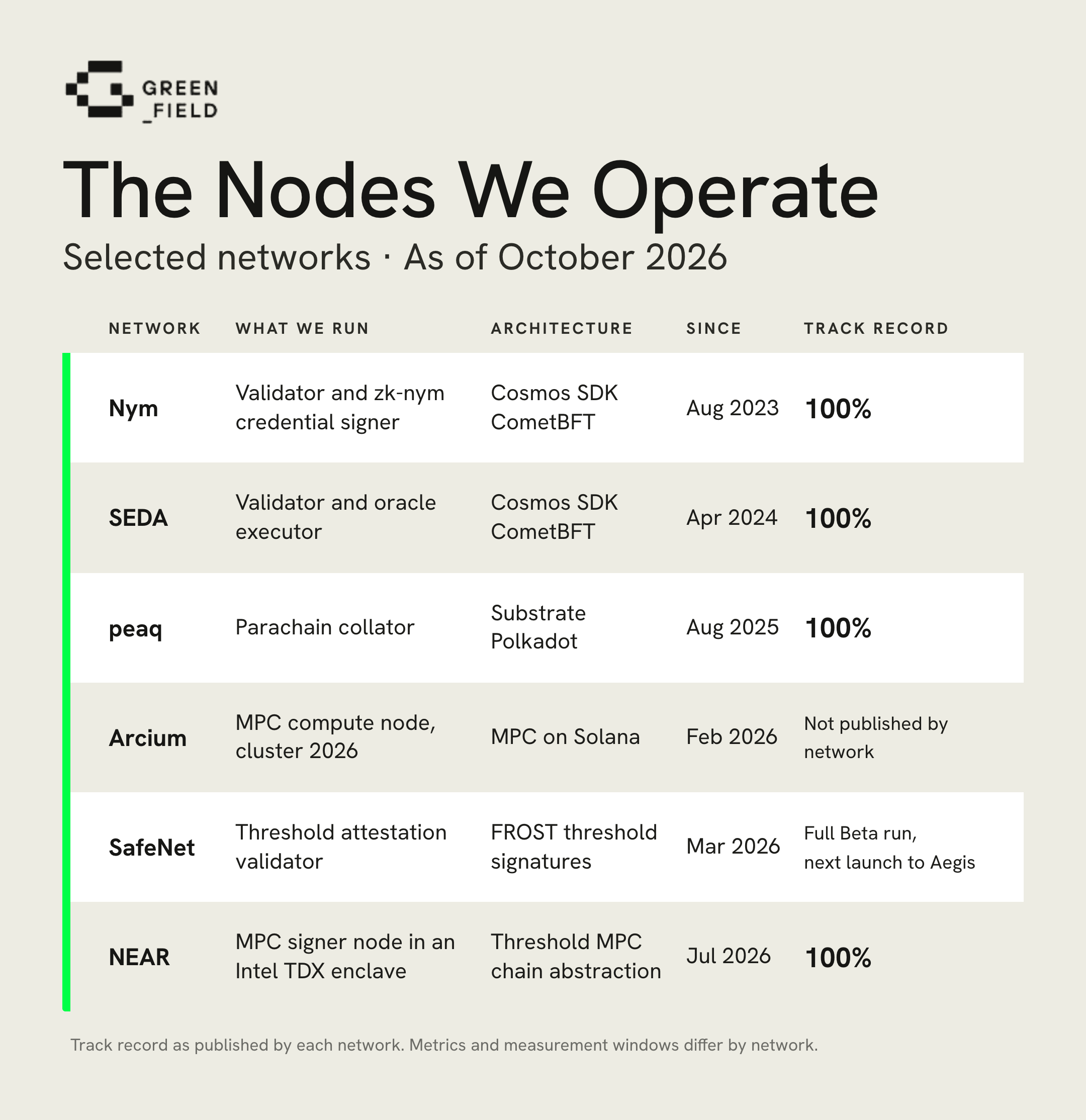
Besides NEAR, we run infrastructure on five other networks: Arcium (encrypted computation), SEDA (data oracles), SafeNet (transaction security for Safe smart accounts), Nym (network-level privacy) and peaq (infrastructure for machines). They do very different things, but in each of them the network sees how an operator behaves, and that behavior affects the network.
The stakes are highest in MPC networks such as Chain Signatures or Arcium, where we run one of the network’s Arx nodes (more here). When a proof-of-stake validator drops offline for an hour, it misses some rewards and the chain moves on. In a threshold network, operators take part in the same computation. An unreliable operator loses income, and on top of that it degrades the service for everyone who depends on it. Anyone who takes on this work has to run it as production infrastructure.
Why we do it
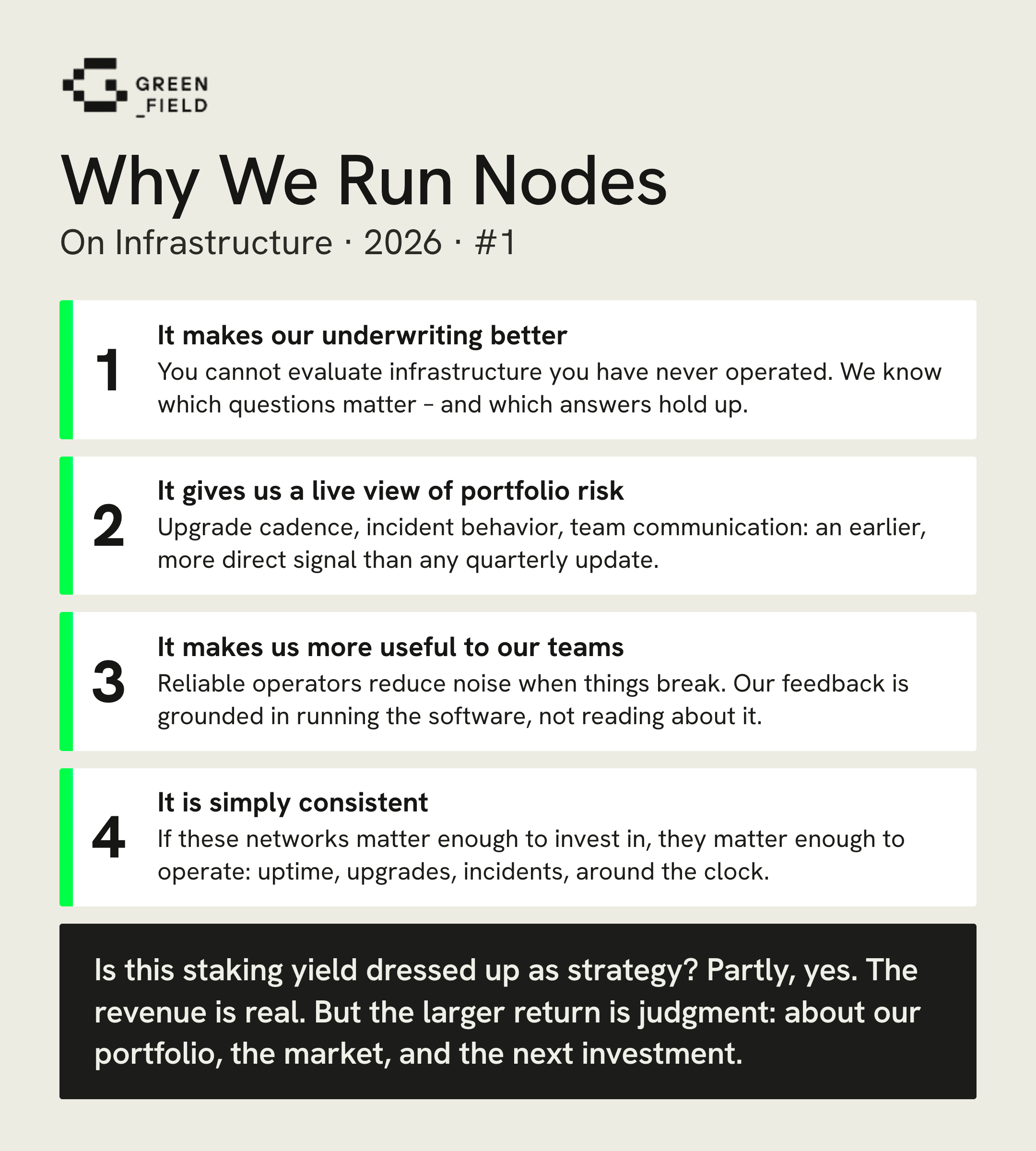
- It improves our underwriting.
It is hard to evaluate infrastructure you have never operated. Running nodes across different consensus mechanisms and failure modes teaches us what a healthy operator set looks like, which problems teams hit before mainnet and which only show up after launch, and which architectures hold up under real load. When we assess a new protocol, our experience with similar systems tells us which questions matter and which answers work. - It shows us portfolio risk as it happens.
For networks already in our portfolio, running a node lets us see the system from the inside: how often it upgrades, how it behaves during incidents, how the team communicates when something breaks. When an upgrade goes wrong, we notice it the same day, usually long before it shows up in a quarterly update. - It makes us more useful to our teams.
When a computation misbehaves on a live network, the protocol team has to work out quickly whether the cause lies in the protocol, the network or a single operator’s misconfiguration. Reliable operators make that diagnosis easier. And because we run the software ourselves, the feedback we give teams before and after investment comes from hands-on experience. - It is consistent.
If we believe these networks deserve our capital, they deserve the routine work too: uptime, upgrades and incident response, from testnet through mainnet and beyond.
Is this staking yield with a strategy label on it? In part. Node operations generate revenue, and in a business where returns take years to materialize, recurring income is welcome. But anyone chasing yield alone has far simpler options than holding a key share in a threshold-signing network inside a hardware enclave. For us, the bigger payoff is better judgment about our portfolio, the market and the next investment.
What it takes
We could run much of this through a professional staking provider and earn similar yield. The provider would keep the knowledge, though. The benefits described above only come from running the machines ourselves, which is why we built a team for it.
That team is Greenfield Labs. It has run our validator and node infrastructure for years, including monitoring, alerting, upgrades and on-call incident response. The results of that work are largely public. The table below gives a sense of them.
If you are designing a network or running one, we are always happy to compare notes on infrastructure. Reach us at labs@greenfieldcapital.com